Abbotsford Entrance Hall

Abbotsford Entrance Hall

Sunday, 31 May 2015

On this day in History...

Every now and then, it's rather fun to pick up Sir Walter Scott's Journal or peruse a collection of letters and find out what was happening on a particular date during his life. We haven't done this yet with the Treasures of Abbotsford Blog and this story is a perfect reminder of why we should!

Today's gem of a letter was penned by Archibald Constable, Scott's publisher of the time. It was addressed to the author at his Edinburgh home on Castle Street and composed on 31st May 1822.

A rather portly Archibald Constable
 Ostensibly, the letter serves as an update on the reception and sales of his latest novel, the Fortunes of Nigel, and Constable claims with somewhat feigned surprise that 'the press is at work again,' meaning that avid readers had already devoured the first print run, quite literally acquiring their copies 'hot off the press.' The picture painted is reminiscent of the hype surrounding a new release in the Harry Potter franchise, or even the latest Apple gadget:

' A new novel from the author of Waverley puts aside, in other words puts down for a time, every other literary performance. The Smack Ocean, by which the new work was shipped, arrived at the wharf on Sunday; the bales were got out by one on Monday morning, and before half-past ten o'clock 7,000 copies had been dispersed from 90, Cheapside.'  
Granted, this is a Victorian piece of Scott memorabilia, but I love these Minton tiles featuring scenes from the Waverley novels. Not easy to come by so I shouldn't think I'll be fashioning my home with them any time soon!


Constable's letter is interesting to me for another reason, serving as a reminder of the number of Scott's high-profile friends and associates that contributed to the diversity of the Abbotsford collections. Archibald speaks of visiting the shop of a Mr. Swaby in Warden Street. Now, I assume this is Warden's Close in Edinburgh's Grassmarket, but I could well be wrong considering he has just been talking about book sales in London. He states that he had been directed to the premises of this 'curious person' Swaby, by his son, Thomas, in order to have a closer look at an antiquated portrait of a monarch spotted there. After some discussion they decide that this is a rare jewel, an unknown portrait of King James IV (perhaps painted by Maynard Wewyck), and Constable forwards it to Scott, trusting that 'ere long, [he] will see it in the Armoury at Abbotsford.' 

The Abbotsford Armoury Wall, complete with James IV portrait purchased by Constable
There are several things going on here, but primarily the portrait is a reminder of one of the greatest successes in their long partnership, the epic poem Marmion: A Tale of Flodden Field published in 1808, the first work in literary history for which the author received a monetary advance from his publisher. Constable is well aware that Scott aims to furnish his baronial home with objects that tell stories, specifically his own version of history if he can help it, and he is keen to contribute to the creation of this shrine to storytelling. His motivation for doing so may well lie in his knowledge that Scott's collecting and his writing have a powerfully symbiotic relationship, as of course do a writer and his publisher.

When I read this letter,  it is not without a raised eyebrow and a smirk as the publisher recommends where in a home such artefacts should be displayed, but perhaps they were more 'jack of all trade' folk in the 1820s! His other purchases that day are no less important to our collection:  'two large elbow chairs, elaborately carved, in boxwood...Swaby assured me they came from the Borghese palace in Rome' and 'a slab of mosaic pavement, which I also destine for Abbotsford.' 

The Borghese Palace, original home of our beautiful boxwood chairs

Constable encourages Scott to accept the pair of chairs as furniture of a calibre appropriate for the Library at Abbotsford, and the mosaic as a hearth-stone for one of the fireplaces. The chairs do indeed still stand either side of the fireplace in the library today but, thankfully, Archibald's mosaic slab forms a handsome table top rather than a hearth, preserving the exquisite piece from excessive wear and tear over the last two centuries. Supposedly there were originally ten Borghese chairs, six of which went to Belvoir Castle in Leicestershire and still stand in their Picture Gallery there to this day. I would dearly like to know where the other two have ended up!

The Abbotsford Library. You can see one of our Borghese chairs to the left of the fireplace


Belvoir Castle has a very different interior to Abbotsford, but if you look closely you can see something familiar!

Hopefully this post illustrates how archival material can help bring collection pieces to life - in just one letter, we have mapped out where these pieces were purchased, by who and for what reasons. If only we were so lucky with mapping the stories of all of our gabions and curiousities! If you think you might know the whereabouts of Swaby's or indeed the other two Borghese chairs, please do get in touch and help us build a clearer picture of this fascinating springtime exchange one hundred and ninety-three years ago. 

'It occured to me that these three articles might prove suitable to your taste, and under that impression I am now induced to take the liberty of requesting you to accept them as a small but sincere pledge of grateful feeling. Our literary connexion is too important to make it necessary for your publishers to trouble you about the pounds, shillings and pence of such things.'  Archibald Constable, 31st May, 1822. 

Thanks for reading!

Kirsty Archer-Thompson
Heritage and Engagement Manager


Saturday, 16 May 2015

Scott on Waterloo

'Bones of horses , quantities of old hats, rags of clothes, scraps of leather and fragments of books and papers strewed the ground in great profusion...'

This was the sight that greeted Sir Walter on his visit to the battlefield in August 1815. Indeed, he had felt full of such fire to make the trip that the venture would see him take his very first steps on foreign soil. The words themselves, although a reflection of Sir Walter's own experiences, come from the eponymous narrator of Paul's Letters to his Kinsfolk, a strange work that purports to be a series of letters penned for five different recipients back home. In effect, this short work is Scott's closest brush with journalism. A brand new edition of this fascinating text, along with The Field of Waterloo and 'the Dance of Death,' was published at the end of April this year and we were delighted to assist Penguin Random House with the cover!


Front Cover Photograph showing the Soldier's Book and Tricolour Cockade from the Abbotsford Collections

On the evening of Tuesday 12th May we were very fortunate to welcome Dr. Paul O' Keeffe, the editor of this new publication, to Abbotsford to introduce his new book and talk a little more about Scott's battlefield visit in the run up to the bicentenary of Waterloo next month. The evening was a wonderful, theatrical affair (with belly laughs aplenty), but it was not without a suitable dose of the macabre.

A very charismatic Paul O' Keeffe as Ruskin at the Edinburgh Fringe Festival

 Battlefield tourism seems a pretty alien pastime to our modern sensibilities; nowadays when we visit the sites
of previous conflict, say the Somme, Culloden or Waterloo,  we are fuelled by a thirst for knowledge or a need to pay our respects. Curiousity and the sense of reaching out and touching history was certainly still a motivating factor for visitors to Waterloo in 1815, but when you consider that a few intrepid onlookers started arriving the morning after the battle, presumably jostling with the local peasants ransacking valuables from the dead, something quite different was at work. There was a powerful sense that Waterloo was the key battle of the time and tourists were eager to acquire souvenirs from the field. 

Napoleonic Plaque displayed in the Abbotsford Entrance Hall

O'Keeffe had the audience grimacing suitably as he evoked the dizzying stench of poorly buried mass graves, human bodies slowly baking just below the surface in the stifling heat of summer. The battlefield area was relatively small and could be explored easily on a day excursion from Brussels but once visitors arrived, they would have found it essential to have packed both quantities of snuff and an iron constitution!

French Cuirassier's Steel and Brass Breast and Back Plate and to the right, a copy of the Imperial Eagle Standard

By the time Sir Walter Scott arrived on the scene, the craze for Waterloo relics had spawned a veritable marketplace where nearby villagers successfully flogged weaponry and cuirasses to awestruck tourists. The bodies had been long stripped but not long buried and Scott encounters an eerie landscape strewn with paper and rags. He set about picking up smaller relics and arranging the purchase of more impressive artefacts over the duration of his trip. One of his most treasured acquisitions, a French soldier's book now in the Abbotsford collections, is photographed on O' Keeffe's book cover. In amongst the cuirasses, sabres, pistols and Napoleonic totems, it is fitting that this little book has been given pride of place. With papers flitting in the breeze before him as far as the eye could see, these military livrets were far from a rarity but they offered a tangible link with an individual life. Scott finds his soldier's book to be a very personal snapshot of a life snuffed out, 'and with it, all his earthly hopes and prospects.'  


Thanks for reading!

Kirsty Archer-Thompson
Heritage and Engagement Manager

Wednesday, 22 April 2015

Bookish Banter


On the 23rd April many countries around the world will be celebrating World Book Day (something that the UK has done in recent years a month earlier). This date was originally chosen to coincide with the date of William Shakespeare's death, probably the most famous wordsmith in history. In honour of Sir Walter's lifelong admiration for the Bard, I thought bookish banter should be the order of the day!

Over the past week or so we have been beavering away, armed with our trusty gloves, archival tape and camera, condition-assessing the books on display in our free to access exhibition in the Abbotsford Visitor Centre. Walter Scott's library at Abbotsford is a rare thing indeed, and not just because Sir Walter thought it the 'handsomest room in Scotland'! Most personal libraries of writers, statesmen and academics end up dispersed or at the very least, depleted after the death of the original owner as items are discarded or claimed by various living relations. Particularly significant collections may be absorbed in their entirety into larger museum or institutional collections. The fact that Scott's library remains wholly intact and that the volumes sit on their shelves in the very position they occupied during the author's life, is remarkable, and one of the many reasons that we now treat the collection as a conservation library. Direct access to the books, even for researchers, is something strictly governed to ensure their long-term survival.  For this reason, one of the most rewarding parts of  my work is selecting a handful of these books for public display, offering visitors a rare glimpse inside the front covers. In the last changeover alone we added an edition of Tam o' Shanter annotated in Robert Burns' own hand, a manuscript revealing Scott's first attempts at copying Icelandic sagas and one of the world's first historical novels, Guerras civiles de Granada

Scott's 1791 edition of Tam o' Shanter


Now, it would of course be a travesty for the literary property of a lifelong bookworm such as Scott not to form a significant part of the exhibition on his life and work. However, from the standpoint of a Heritage team, paper is one of our more high-maintenance friends! Every January we have a complete changeover of all the books displayed in the Visitor Centre and then every three months, all those books have to be assessed to see how they are coping with display, with very few books permitted to remain on display for more than six months at a time. On the face of it, this may seem nonsensical. How could a book visibly change in a matter of months whilst locked away in a case?! You'd be surprised.   

Scott's personal bindings displaying his portcullis symbol and motto: Clausus Tutus Ero (roughly translates to 'Closed in I am safe), quite appropriate for the contents of a conservation library! 


When shelved, the books at Abbotsford are kept in an stable, environmentally controlled setting, packed fairly tightly with a gap at the back to ensure adequate air flow. Some of the books owned by Scott are contemporary with his life and writings but others were antiquarian treasures even by his standards. For books, the display process is all about finding the right angle for pitch and opening that puts the least strain on the binding. Sometimes, fascinating books we would love to display simply don't make the cut because they're too fragile. Others need to be carefully monitored to ensure they don't start to warp or gape when you attempt to close them and this is what we've been checking and photographing over the last few days for those books currently on open display. Pages also need to be turned to try and mitigate the damaging effects of UV light. For those books that are already showing any signs of structural deterioration at this three months check, it is the end of the road for their display and replacements on a similar theme must be sought. And thus the cycle continues.... but we wouldn't have it any other way!

The visual warning signs that a volume is not suited to prolonged display - Scott's copy of Halidon Hill.

The moral of the story is this: if you are a particular fan of an exhibition or museum that displays rare books, make sure you return every few months because you're always likely to see something new. For Abbotsford this time will come in the summer, so why not come and see our latest discoveries for yourself? 

Thanks for reading!

Kirsty Archer-Thompson
Heritage and Engagement Manager    


Monday, 13 April 2015

Welcome to our Blog!


Welcome to our Blog!


Hello and a very warm welcome to our very first blog post on behalf of the Abbotsford Heritage and Engagement team! Here at Sir Walter Scott's 'Conundrum Castle', quite literally stuffed to the rafters with antiquarian treasures, we thought it was high time that we shared some of the more quirky and unusual things that we intrepid souls in the Curatorial Department experience on a daily basis. Over the coming weeks and months we will try and shed some more light on particular objects in the collection, discuss potential research projects and interesting unanswered questions and share amusing anecdotes of the weird and wonderful things we end up turning our hands to. Now, as is so often the case with museums and charitable institutions, we are a busy team of two and will be seeking funding and voluntary support to allow us to really develop this blog to act as a tool for anyone who is curious (or indeed serious) about Scott to get something really meaningful from following us. In the meantime, we will try and share as much as we can.

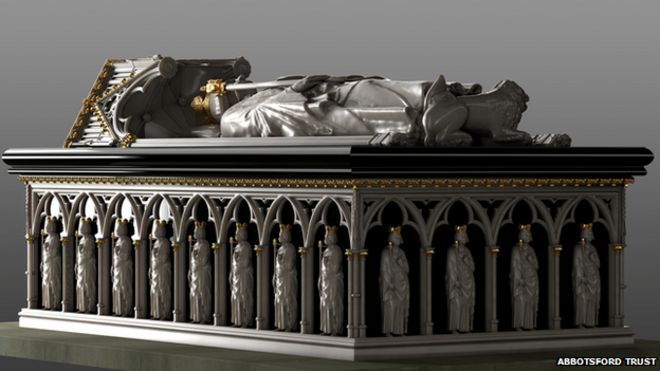
The digital reconstruction of Robert the Bruce's tomb 
Abbotsford has been open to the public following a major restoration project for almost two years now, so you might be wondering 'why start a blog now?' Well, this week seems like a particularly good time to start sharing our stories as we celebrate the opening of our new 2015 exhibition: 'The Lost Tomb of Robert the Bruce.' This exhibition is the fruit of our first collaborative project with a number of other Scottish heritage bodies, making sharing new ideas and research something that is right at the forefront of our minds. Now, of course, it is our aim that readers will come to the house and see the display for themselves so don't expect to read too many exhibition spoilers here! What I do want to discuss is why I think Scott would have been pleased as punch to have the remaining fragments of the Bruce's tomb here in his beloved home, particularly as so many of the other fragments are far more ornate that the one he managed to acquire!

The remaining medieval marble fragments found when work was beginning on building the new parish kirk at Dunfermline in 1818 


Scott and the Bruce


Now, considering his penchant for augmenting history with myth, particularly with regard to reimagining the past of his native Scotland, it will come and no surprise that King Robert I fascinated Scott. 2015 is actually the bicentenary of The Lord of the Isles, one of his final poetical works and one that focuses on the exploits of the exiled Bruce in the seven years leading up to the famous victory at Bannockburn. Not only do we now know that he managed to acquire a piece of the Bruce's impressive marble tomb long since destroyed, but he also proudly displayed a cast of the monarch's skull here at Abbotsford. We know that the original cast of the skull was made by the sculptor, William Scoular, following the exhumation of what was believed to be the King's remains in 1818 whilst building work was going on at Dunfermline Abbey. This cast is now kept in the Anatomy Department of the University of Edinburgh and we know that further casts were taken from this original, one of which proved irresistible to the magpie eye of Sir Walter Scott.


Scott's Cast of the Bruce's Skull
Another rather fun fact is that Scott also seems to have had a hand in bringing that famous scene of the industrious spider inspiring the downtrodden king into the popular consciousness, along with the sentiment of the popular expression 'if at first you don't succeed, try, try again.' The spider story appears in Tales of a Grandfather,written primarily for his beloved six year-old grandson, John Hugh Lockhart and published in 1828:

    "Bruce, seeing the success of the spider, resolved to try his own fortune; and as he had never before gained a victory, so he never afterwards sustained any considerable check or defeat. I have often met with people of the name Bruce, so completely persuaded of the truth of this story, that they would not on any account kill a spider; because it was that insect which had shown the example of perseverance, and given a signal of good luck, to their great namesake." 
Although this was the first time this parable of perseverance had entered the public sphere in any major way, the first reference to this small arachnid catalysing events in Scotland's history is buried in an account by David Hume of the exploits of the 'Black' Douglas, Bruce's ally. Now it turns out that Scott has a 1644 edition of this particular book in his library here at Abbotsford: The history of the house and race of Douglas and Angus written by Mr. David Hume of Godscroft , along with a host of other antiquarian historical books on the subject, so we can be pretty sure of where his inspiration for the moral lesson came from! 

Throughout Scott's writings you get the sense that he was captivated by the romanticised outlaws of the past and he collected items connected with them, sometimes very spuriously, as if they were magical amulets or totems. As Scotland's most famous warrior king, the tomb fragment is one of the most powerful example of this activity in relation to a monarch and I am positive that the great man himself would be thrilled to see the remaining fragments on public display together; sadly all that now remains of a once grand medieval monument to rival the French tombs of old. 

You can visit 'The Lost Tomb of Robert the Bruce' free of charge with a house admission ticket until November 30th 2015.  To find out more about visiting us, click here.

Thanks for reading!

Kirsty Archer-Thompson 
Heritage and Engagement Manager