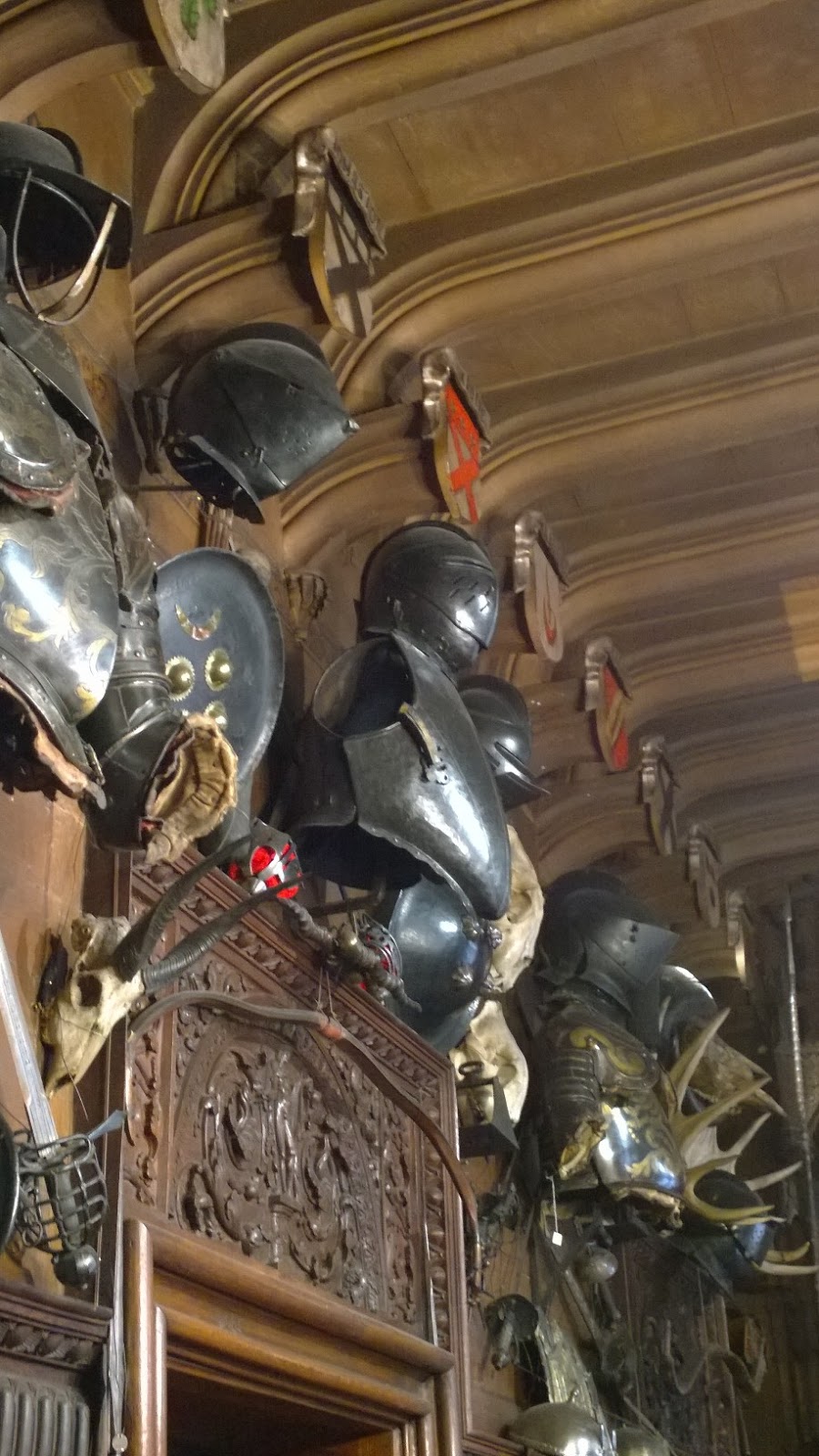
Abbotsford Entrance Hall

Abbotsford Entrance Hall
Showing posts with label Conservation. Show all posts

Monday, 6 June 2016

A Tale of Two Harps


Our collections here tend to be fairly static because of their very nature; we are not a Walter Scott museum and don't buy filler material on a theme or on the man as a general rule. We exist to showcase the Abbotsford collection, care for this building, repatriate items that may have been lost over the years and to share our passion and celebrate our commitment to caring for Scott's legacy. For this reason, new acquisitions are somewhat rare. And they don't get much more unusual than a stunning Regency period harp! Those of you that have visited us before might be scratching your heads right about now, muttering under your breath that you were sure that there was already a harp at Abbotsford...and of course you would be right. Here she is, a gilt and black Sebastian Erard harp with neoclassical decoration, manufactured in 1820 according to her unique serial number and purchased by a Mrs J. Lockhart (nee [Charlotte] Sophia Scott):

Sophia Scott's 1820 harp
We know that Sophia was playing the harp with considerable skill long before 1820 (she was born back in 1799, the eldest child of Walter and Charlotte Scott), and she was doing so much to the great pleasure of her father and to the delight of many a guest to grace these 'halls' as Scott affectionately termed them. This, clearly, cannot be the instrument that Sophia played so enchantingly for her audience, one of whom proclaimed that the spectacle seemed almost an  'act of religion.' This young woman, keen to showcase her refined capabilities in her formative years, seemed capable of melting hearts. And this is rather apt, for this particular instrument is far more likely to be piece purchased in her name by her husband, perhaps as a wedding present in 1820. During their two-year courtship, John Gibson Lockhart would have spent many an evening listening to musical entertainment in the Drawing Room of the original Cartley Hole Farmhouse (we must remember that the Drawing Room as we know it today had not yet taken shape). Perhaps it was in the throes of musical sentimentality that Lockhart fell for Sophia a la Mary Crawford in Jane Austen's Mansfield Park:  

"A young woman, pretty, lively, with a harp as elegant as herself, and both placed near a window, cut down to the ground, and opening on a little lawn, surrounded by shrubs in the rich foliage of summer, was enough to catch any man's heart." 

Or perhaps I am getting carried away..!

Lady with a Harp: Eliza Ridgely", portrait by Thomas Sully, 1818
Regardless of the intricacies of their romance, we can say definitively that there must have been another harp. Mr. Pole was the 'harper,' the tutor who taught both of Scott's daughters for many years, indeed tried to offer Scott money when he found himself in serious financial difficulties in 1826. Anne's musicianship is, I think, so often overlooked simply because scholars have tended to cast Anne in the role of a poor substitute for her artistically merited sister, and made much of the green-eyed monster that rears its head in some of the episodes or choice comments that have survived in letters:

"Sophia is rather too much with her harp... I wish she would take example of old times and hang it up." 
Anne Scott
Portrait of Anne Scott in the Abbotsford Drawing Room
I have yet to find any reference to Anne's aptitude at the harp but she certainly did play, so it's not as if she is condemning musicianship itself. What she does seem to have, without a shadow of a doubt, is distaste for her sister's love of the limelight! When the girls are mentioned playing music together at Abbotsford, there are a number of instrument combinations mentioned: harp and guitar, harp and viol and piano and harp. It is very possible that Anne could play a number of different instruments capably, and was less devoted to the harp in particular because this was so much Sophia's speciality and every sibling naturally strives for a measure of individuality. Having said that, competition amongst siblings is just as natural...

So without further ado, enter stage left: harp number two! This piece was discovered in Oxfordshire in the hands of a private owner who thoughtfully approached the Abbotsford Trust in March 2014 with details of the piece and its supposed connection with Anne. Further research by our team using the serial number on the harp traced it through the company archives to its original purchase for Anne Scott in 1818. It's another Erard double-action harp, but it is distinct in its design. Although the applied plasterwork with it's Grecian assortment of caryatids, winged lions, gryphons, Greek masks and acanthus leaves is a constant, the soundboard decoration is very different and the colour of the the harp's body, a luscious green now sun-bleached in places, is beautiful. We were fortunate enough to be able to purchase the piece through the kind donation of a benefactor, and this donation has also enabled us to send both harps off for treatment with furniture conservator, Sarah Gerrish.


The arrival and unveiling of Anne Scott's 1818 harp

The majority of specialist treatment was reserved for the new piece, with Sophia's instrument undergoing a full conservation clean, using a combination of dry brushwork, white spirit on the areas of copper alloy and 5% Tri-Ammonium Citrate and water on the gilding. The body of the harp was then waxed with a micro-crystalline product to protect the finish. Anne's harp needed a lot more in the way of 'consolidation' work, i.e., stabilising the piece, particularly the gilt on the soundboard and body of the harp. Rabbit glue was used on the many loose elements (animal glues are always used in conservation repairs) and the decorative losses on the soundboard were 'tinted in', meaning that instead of attempting to actually recreate the decoration itself to fill gaps which is not really what we want to be doing, Sarah uses water-based acryllic paint to infill the gaps to match the surrounding base colour. This makes areas of loss less visible and the surrounding areas less prone to flaking without trying to reimagine the piece. The two harps arrived back at Abbotsford last week and the difference in their appearance was astounding.  The important thing now is to ensure that we minimise the danger of light damage to Anne's harp by closing the shutters in the Drawing Room whenever we can and positioning the piece in such a way that its delicate soundboard is protected.  

The soundboard of Anne's harp before and after tinting


Now, having already established that the black and gold harp is not the one Sophia played here when she was an adolescent, we are left with a bit of a conundrum. In 1818 when the green harp was purchased, Sophia was 19 and Anne, 15/16. It is implausible that there was no harp at Abbotsford preceding this date and this missing instrument would have presumably belonged to Sophia. This lost harp may even have been exactly the same model as Anne's 1818 instrument, although whether a doting father would have opted for that course of action is open to debate! The whereabouts of this third harp are now unknown but it was presumably replaced by our elaborate 1820 harp purchased in the year of Lockhart and Sophia's marriage. The most likely scenario is that Anne received the green harp as a sixteenth birthday present and perhaps Scott was further encouraged to make this purchase by Lockhart's simultaneous arrival on the scene, heralding the countdown to the spiriting away of his favourite musical entertainer, Sophia. The supposition is that following her marriage, Sophia initially keeps her 1820 black and gilt harp at their Great King Street residence in Edinburgh before the family move to London in 1825, when it is decided the 1820 instrument will be stored at Abbotsford for use during the family's summer vacations. Perhaps she took her original harp, the mystery third instrument, with her to London, or perhaps it was sold off at this point. Anne would have then found herself with the 1820 harp at her disposal for the majority of the year whilst nursing her father through his financial strife and final years of ill health. There would have been no need for her 1818 instrument and it could well have been sold on or gifted to somebody at this point. How it ended up in Oxfordshire all those years later is a mystery, but at least one with a happy conclusion.

The two harps on display together
Placing Anne's instrument underneath her beautiful portrait in the Drawing Room was actually incredibly moving. This was presumably more 'her' room than any other member of the Scott family, considering Sophia had already married and moved out by the time that the 1822-4 east extension was completed and her mother had died shortly after this in 1826. I feel very privileged that this process of bringing the harp to Abbotsford has concluded under my watch and that through this story we can help Anne Scott to step out from her sister's shadow.

Thanks for reading!

Kirsty Archer-Thompson
Collections and Interpretation Manager  


Sunday, 22 November 2015

Winter is Coming...

As we have a good old British grumble about the first chilly spell of the winter, I couldn't resist naming this post after the famous phrase from George R. R. Martin's epic fantasy series A Song of Ice and Fire, better known to many as Game of Thrones. After all, Martin has claimed that Scott's Waverley Novels, particularly Ivanhoe, had a great influence on his work. But more on this another time...

Ser Loras Tyrell rides in the joust at the Tourney of the Hand in Game of Thrones. The Canadian writer Margaret Atwood refers to the saga that has taken the world by storm as 'Ivanhoe with the rape and gutting scenes included.' Gritty would have been a gentler turn of phrase!

The arrival of winter heralds a time of change for Abbotsford, and oddly it isn't a case of closing everything down at the end of November as our seasonal opening times may suggest. Visitors are still enjoying the house and collections as I sit here typing this and it couldn't be a more beautiful example of a crisp and still winter's day, but underneath the calm water we are paddling away ferociously!

A lot of people approach me and ask out of genuine curiosity what goes on here when the house closes to the public, and indeed why it has to close at all. I have no doubt that, although the number of intrepid visitors would be small in the colder months, we will always have people keen to come and explore Abbotsford, no matter what the weather. And so, this post is an attempt to try and explain to those of you that might not know, why so many historic houses tend to close in the winter and what is going on behind those closed shutters. 

Abbotsford with a beautiful dusting of snow last winter

Of course some houses and stately homes are family-owned and close in the winter so that the occupiers can 'reclaim' particular wings or key rooms in the house, particularly as Christmas approaches. With Abbotsford in the hands of a charitable trust, this isn't something we have to worry about, although we do have an 1850s wing of the house dedicated to private holiday accommodation which is open year-round for bookings. Sometimes historic houses close because of the risk posed by adverse weather conditions and the difficulties of ensuring access and safety around the gardens, the approach to the house and even out on the wider estate. This is certainly something we are not immune from here at Abbotsford, even though the site as a whole is more bijoux than many of the other stately homes in the area. Locals will know that the winters in the Borders can be extremely harsh and becoming snowed in in this little riverside hollow is not unheard of!

The primary reason that we close between December 1st-February 29th is in order to conduct an intensive period of museum housekeeping across the interiors of Abbotsford known as 'conservation cleaning'. In a nutshell, this signifies a very different type of cleaning than you or I would conduct in our homes - it isn't a case of applying liberal amounts of elbow grease and coating everything in Brasso and detergents! This approach  is a method of cleaning interiors and artefacts that focuses on non-invasive techniques, thereby protecting vulnerable historic decoration and antiques from harm. This means we always have to steer away from traditional chemical cleaning agents and use an entirely separate kit designated for the Scott-period interiors at Abbotsford. Some examples of the type of things you would find in our kits are: HEPA filter museum vacuums of various sizes complete with specialist attachments, a battalion of brushes with different types of natural bristles, including goat hair and pig hair, deionized water, microcrystalline wax polish, cotton swabs, gauze and an awful lot of powder-free gloves! 

We cannot wait to eliminate the layer of dust that has settled on the tops of the helmets in the Entrance Hall! 

Although our daily housekeeping routines tackle the dust and dirt that can build up around floor and shoulder height, the closure of the house allows us to work through the rooms from ceiling height downwards in a circular motion to ensure that the dust we disturb falls downwards and is removed as we go. One of the main reasons we have so much to do here in the winter months is the sheer amount of material here in Scott's 'museum for living in'.  Put simply, dust has no shortage of surfaces to settle on! Abbotsford's ceilings are not as high as in many other historic houses but reaching the cornicing and the tops of paintings and shelves still requires building the tower scaffolding and using a mid-range platform for cleaning the wall-mounted items. We approach the very high areas on a rotational basis and this year it is the turn of the Chapel and Library, along with the Entrance Hall which always requires cleaning at height due to the position of the room in the house and the array of collections items it contains. 

Tackling the picture frames and the cornicing in the Chinese Drawing Room in February 2015

I'm sure there will be many people out there who are thinking that Scott certainly didn't dangle around at perilous heights cleaning all these artefacts on the walls and that in all probability he wanted it to look dusty and antiquated, and I'm sure there is an element of truth in that, judging from the brief he gave David Ramsay Hay for artificially aging the paintwork in the Entrance Hall. But this isn't about aesthetic principles, although all of the team involved in the closure work would love for their work to be noticed and commented upon; sadly because our work does not make everything gleam, this tends not to be the case! Our main aim is to protect the collections items by eradicating any impacted dust and grime. In our own homes, we may well see a little dust as no harm whatsoever and certainly in museum environments, there are plenty of reasons why you shouldn't over zealously clean surfaces, but in actual fact a buildup of dirt attracts two things that we try and avoid at all costs: moisture, which can be harmful in itself, and insect pests that seek moist environments and live by feeding off the proteins in dust, amongst other foodstuffs. 

One of the joys of conservation cleaning: a different view of something we know so well - Henry Raeburn's 1809 portrait of Scott
When I mention museum vacuums to people, even some of our volunteers, they often give me a  withering look as if they suppose that the prefix 'museum' when used in equipment purchasing has the same effect as the word 'wedding'! In some cases this is most certainly true and you can find fantastic substitutes that are not branded for museum or conservation work for a fraction of the cost, as long as you keep a careful eye on what things are made from. However I think these vacuums are fantastic pieces of kit, offering complete adjustment of suction so that you can hoover carpets and hard floors comprehensively alongside delicate textiles, books, plasterwork and carved wood, all with the same appliance. They come with many fine brushes and nozzles so that you can reach and remove the dirt ingressed around the spines of books and in the crevices of carvings and gilt frames. Not to mention the fact that one of them is a backpack museum vacuum for working at height, affectionately known by our  team as the 'Ghostbuster vac'! When we are using one of the vacuums on delicate objects, particularly books and textiles, we always start on the lowest suction setting and cover the end of the narrow tube with a square of gauze or fine netting secured with a plastic band. This is a method used to examine whether the cleaning is removing more than just dust, such as detached leather fragments or textile threads. If this is the case the item cannot be vacuumed and must be hand brushed or in some cases, left well alone if it is simply too fragile to be handled. 

Our largest Museum vacuum or the 'Ghostbusters Vac'.

The 9,000 or so books in the Abbotsford Library are all hand cleaned over the winter, some using direct appliance of the museum vacuum and others, perhaps of a significant age or with a binding in a state of deterioration, are hand brushed into a box with a hole in the side for the vacuum attachment. This way the dirt is contained and picked up without risking harm to the book. With many of the key insect pests that can cause havoc in museums enjoying devouring a good book, so to speak, this is also the time to visually check each volume and note down alterations in condition or areas of concern. It's a huge task and one in which we have to be extremely careful to preserve the order of Scott's books on the shelves, just as he left them in 1832. This preserved order is of course one of the most famous attributes of the Abbotsford Library. Last year the books took our team just under four weeks to complete and this year we're hoping to beat that record!

One of the trickiest areas for book cleaning is the Study Gallery. 

Of course cleaning isn't the only thing going on here over the next 2-3 months. We are also completing essential maintenance works across the site and planning ahead for the changeover of the Visitor Centre exhibition books in early January. I'm also working on a very exciting project for our new 2016 exhibition in the historic house, launching at the beginning of April. Blog readers will get the first news about this hot off the press in due course...

I shall be photographing our behind the scenes activities over the next few weeks to share with you all in a winter roundup early next year, so do keep checking the Abbotsford Collections blog or sign up for updates to receive a prompt when the next post goes live.          

Thanks for reading and wrap up warm!

Kirsty Archer-Thompson
Collections and Interpretation Manager

Wednesday, 17 June 2015

Field Marshal Blücher's Tiny Teapot and Other Adventures...


Earlier this week, our volunteers were treated to a trip up to the National Museum of Scotland in Edinburgh. As with all staff get-togethers, it was long overdue and offered a rare opportunity for volunteers based in different areas to meet one another properly and have some fun!

Of course, this was a cultural outing and it was my mission to put together an itinerary that had some relevance to Scott. With a sprinkling of fairydust from external funders, we can ensure that this is the first of a series of excursions that will help our volunteers make associations and connections with other historical sites, people in history and major events that shaped Scott's worldview.

Perhaps no event is more significant in Scott's lifetime than the battle of Waterloo, especially when you consider it is the culmination of a pervading mood of fear and hostility that had been simmering away in Britain ever since the French Revolution, at least amongst the conservative faction. Now, I shan't harp on about Waterloo again after such a recent blog post on the subject (even if it is tempting within a whisker of the bicentenary itself), but I would like to draw attention to the first pitstop on our Scott-themed tour of NMS: an excellent little exhibition entitled 'Waterloo: After the Battle,' curated by Dr. Stuart Allan.

Our Volunteers Malcolm and Will putting Dr Allan through his paces

We were lucky enough to have Dr. Allan show us around the displays which really helped to bring everything to life. Perhaps most poignant for the Abbotsford troupe was the chance to see the captured bronze eagle of the French 45th Infantry, one of two Napoleonic totems taken by the British forces during the battle. 


The Eagle of the 45th

Why is it relevant to Scott? Well, we have an eagle at Abbotsford, albeit something a little less 'shiny...' For some time it was rumoured that this was the real deal, until it was pointed out that the whereabouts of the two captured imperial eagles was already known! Our wooden version is, we think, more likely to be a stage prop that accompanies a set of flags we have in the archives, one of which is a replica standard of the French 105th Infantry, the other regiment to lose its colours on the 18th June.  Other artfefacts on display in this exhibition included Napoleon's sugar bowl, part of a wonderfully ornate tea service (which I am sure Scott would have moved heaven and earth to get hold of if he could have done), commemorative Black Watch pottery fired in 1816, and my personal favourite: a tiny little silver teapot that supposedly belonged to Field Marshal Blücher, the septuagenarian commander of the Prussian forces. I guess he wasn't quite as butch as history would have you believe!

It appears the Prussians also marched on tea.

Wonderful rustic Scottish pottery from Portobello
After wolfing down a tasty lunch, we were treated to a fantastic tour of the Scottish galleries with George Dalgleish, Keeper of Scottish History and Archaeology. George is an Abbotsford Trustee and as such, he was able to give us a fantastic overview of the objects in the museum collection that Scott had owned, written about and seen exhibited. One of the real treasures of Abbotsford, the Torrs Chamfrein, actually resides at the National Museum after it was sold decades ago by Scott's descendents to avert ever-present financial difficulties. Luckily, the museum provided us with their Victorian replica of the artefact at the time of that transaction so visitors can still see a version of the piece in its rightful setting here at Abbotsford.


The Torrs Chamfrein at NMS, once belonging to Sir Walter Scott

Chamfreins, being ceremonial or armoured headpieces for horses, are interesting things and this one in particular is a bit of a conundrum.  There are fine examples from Roman Britain in other institutions, but this Iron Age example, dated to approximately 200BC is more likely to have been ritual in function. Whether it was made for animal or human is very much open to debate; perhaps in a shamanistic ceremony it transformed an individual from one thing to another. The pony cap and horns were unearthed in a peat bog at Torrs Farm in Dumfries and Galloway in the 1820s and given to Scott as a curiousity worthy of his 'museum for living in'. Having been found initially as two separate items in the same location, it is unclear how the cap and horns marry together both physically and chronologically but they have been displayed as one piece for some time now. Until new research can find a way to navigate the minefield of 'cult archaeology', the enigma of the Torrs chamfrein continues. 

Passing through the medieval gallery, we caught a glimpse of the famous Lewis chessmen. We were all surprised to find that Scott narrowly missed out on acquiring these, in reality due to his ailing health.


A Selection of the Lewis Chessmen
An Edinburgh Antiques dealer had put his collection of chesspieces up for the consideration of the Keeper of Manuscripts at the British Museum on the 17th October 1831 and Sir Walter Scott happened to see the relics, being present to consult manuscripts for research purposes. His journal entry that day is as follows: 'the morning beautiful today, I go to look after the transcripts in the Museum and leave a card on a set of chess men thrown up by the sea on the coast of Scotland which were offered for £100.' As the twists and turns of fate would have it, it was actually his friend Charles Kirkpatrick-Sharpe who ended up owning eleven pieces of the much larger collection. I wonder how different things would have been if he hadn't been so unwell at the time and what a joy the chesspieces would have been to have at Abbotsford!

After having wended our way past the towering Scottish Maiden, a guillotine that features in Scott's novel The Abbot, the final highlight of our tour (and there were many more than I can possibly cover here) was seeing the sporran that inspired that famous passage in Rob Roy:
 "I advise no man to attempt opening this sporran till he has my secret,'' said Rob Roy; and then twisting one button in one direction, and another in another, pulling one stud upward, and pressing another downward, the mouth of the purse, which was bound with massive silver plate, opened and gave admittance to his hand. He made me remark, as if to break short the subject on which Bailie Jarvie had spoken, that a small steel pistol was concealed within the purse, the trigger of which was connected with the mounting, and made part of the machinery, so that the weapon would certainly be discharged, and in all probability its contents lodged in the person of any one, who, being unacquainted with the secret, should tamper with the lock which secured his treasure."
 
Gentlemen, beware! Sporran clasp concealing two small steel pistols


Some cautionary tales around the Scotch Maiden

 Now, as with all items that occupy that murky border country between history and myth, this NMS item is popularly referred to as Rob Roy's sporran, and indeed it must have inspired that passage in the novel, but there is no evidence whatsoever that it ever belonged to the folk hero. As ever with these things, the popular imagination sides with the storyteller. And isn't it more fun that way? Scott would have most certainly thought so. 

I hope you've enjoyed our little virtual excursion though the National Museum of Scotland. 

Thanks, as ever, for reading!

Kirsty Archer-Thompson
Heritage and Engagement Manager


one button in one direction, another in another…when the mouth of the purse…opened… a small steel pistol was concealed within the mounting,…so that the weapon would be discharged’ - See more at: http://www.26treasures.com/creationstories/sporran-clasp-four-concealed-pistols-stuart-delves#sthash.NiWKwVcx.dpuf


Wednesday, 22 April 2015

Bookish Banter


On the 23rd April many countries around the world will be celebrating World Book Day (something that the UK has done in recent years a month earlier). This date was originally chosen to coincide with the date of William Shakespeare's death, probably the most famous wordsmith in history. In honour of Sir Walter's lifelong admiration for the Bard, I thought bookish banter should be the order of the day!

Over the past week or so we have been beavering away, armed with our trusty gloves, archival tape and camera, condition-assessing the books on display in our free to access exhibition in the Abbotsford Visitor Centre. Walter Scott's library at Abbotsford is a rare thing indeed, and not just because Sir Walter thought it the 'handsomest room in Scotland'! Most personal libraries of writers, statesmen and academics end up dispersed or at the very least, depleted after the death of the original owner as items are discarded or claimed by various living relations. Particularly significant collections may be absorbed in their entirety into larger museum or institutional collections. The fact that Scott's library remains wholly intact and that the volumes sit on their shelves in the very position they occupied during the author's life, is remarkable, and one of the many reasons that we now treat the collection as a conservation library. Direct access to the books, even for researchers, is something strictly governed to ensure their long-term survival.  For this reason, one of the most rewarding parts of  my work is selecting a handful of these books for public display, offering visitors a rare glimpse inside the front covers. In the last changeover alone we added an edition of Tam o' Shanter annotated in Robert Burns' own hand, a manuscript revealing Scott's first attempts at copying Icelandic sagas and one of the world's first historical novels, Guerras civiles de Granada

Scott's 1791 edition of Tam o' Shanter


Now, it would of course be a travesty for the literary property of a lifelong bookworm such as Scott not to form a significant part of the exhibition on his life and work. However, from the standpoint of a Heritage team, paper is one of our more high-maintenance friends! Every January we have a complete changeover of all the books displayed in the Visitor Centre and then every three months, all those books have to be assessed to see how they are coping with display, with very few books permitted to remain on display for more than six months at a time. On the face of it, this may seem nonsensical. How could a book visibly change in a matter of months whilst locked away in a case?! You'd be surprised.   

Scott's personal bindings displaying his portcullis symbol and motto: Clausus Tutus Ero (roughly translates to 'Closed in I am safe), quite appropriate for the contents of a conservation library! 


When shelved, the books at Abbotsford are kept in an stable, environmentally controlled setting, packed fairly tightly with a gap at the back to ensure adequate air flow. Some of the books owned by Scott are contemporary with his life and writings but others were antiquarian treasures even by his standards. For books, the display process is all about finding the right angle for pitch and opening that puts the least strain on the binding. Sometimes, fascinating books we would love to display simply don't make the cut because they're too fragile. Others need to be carefully monitored to ensure they don't start to warp or gape when you attempt to close them and this is what we've been checking and photographing over the last few days for those books currently on open display. Pages also need to be turned to try and mitigate the damaging effects of UV light. For those books that are already showing any signs of structural deterioration at this three months check, it is the end of the road for their display and replacements on a similar theme must be sought. And thus the cycle continues.... but we wouldn't have it any other way!

The visual warning signs that a volume is not suited to prolonged display - Scott's copy of Halidon Hill.

The moral of the story is this: if you are a particular fan of an exhibition or museum that displays rare books, make sure you return every few months because you're always likely to see something new. For Abbotsford this time will come in the summer, so why not come and see our latest discoveries for yourself? 

Thanks for reading!

Kirsty Archer-Thompson
Heritage and Engagement Manager