Abbotsford Entrance Hall

Abbotsford Entrance Hall
Showing posts with label Collections. Show all posts

Monday, 6 June 2016

A Tale of Two Harps


Our collections here tend to be fairly static because of their very nature; we are not a Walter Scott museum and don't buy filler material on a theme or on the man as a general rule. We exist to showcase the Abbotsford collection, care for this building, repatriate items that may have been lost over the years and to share our passion and celebrate our commitment to caring for Scott's legacy. For this reason, new acquisitions are somewhat rare. And they don't get much more unusual than a stunning Regency period harp! Those of you that have visited us before might be scratching your heads right about now, muttering under your breath that you were sure that there was already a harp at Abbotsford...and of course you would be right. Here she is, a gilt and black Sebastian Erard harp with neoclassical decoration, manufactured in 1820 according to her unique serial number and purchased by a Mrs J. Lockhart (nee [Charlotte] Sophia Scott):

Sophia Scott's 1820 harp
We know that Sophia was playing the harp with considerable skill long before 1820 (she was born back in 1799, the eldest child of Walter and Charlotte Scott), and she was doing so much to the great pleasure of her father and to the delight of many a guest to grace these 'halls' as Scott affectionately termed them. This, clearly, cannot be the instrument that Sophia played so enchantingly for her audience, one of whom proclaimed that the spectacle seemed almost an  'act of religion.' This young woman, keen to showcase her refined capabilities in her formative years, seemed capable of melting hearts. And this is rather apt, for this particular instrument is far more likely to be piece purchased in her name by her husband, perhaps as a wedding present in 1820. During their two-year courtship, John Gibson Lockhart would have spent many an evening listening to musical entertainment in the Drawing Room of the original Cartley Hole Farmhouse (we must remember that the Drawing Room as we know it today had not yet taken shape). Perhaps it was in the throes of musical sentimentality that Lockhart fell for Sophia a la Mary Crawford in Jane Austen's Mansfield Park:  

"A young woman, pretty, lively, with a harp as elegant as herself, and both placed near a window, cut down to the ground, and opening on a little lawn, surrounded by shrubs in the rich foliage of summer, was enough to catch any man's heart." 

Or perhaps I am getting carried away..!

Lady with a Harp: Eliza Ridgely", portrait by Thomas Sully, 1818
Regardless of the intricacies of their romance, we can say definitively that there must have been another harp. Mr. Pole was the 'harper,' the tutor who taught both of Scott's daughters for many years, indeed tried to offer Scott money when he found himself in serious financial difficulties in 1826. Anne's musicianship is, I think, so often overlooked simply because scholars have tended to cast Anne in the role of a poor substitute for her artistically merited sister, and made much of the green-eyed monster that rears its head in some of the episodes or choice comments that have survived in letters:

"Sophia is rather too much with her harp... I wish she would take example of old times and hang it up." 
Anne Scott
Portrait of Anne Scott in the Abbotsford Drawing Room
I have yet to find any reference to Anne's aptitude at the harp but she certainly did play, so it's not as if she is condemning musicianship itself. What she does seem to have, without a shadow of a doubt, is distaste for her sister's love of the limelight! When the girls are mentioned playing music together at Abbotsford, there are a number of instrument combinations mentioned: harp and guitar, harp and viol and piano and harp. It is very possible that Anne could play a number of different instruments capably, and was less devoted to the harp in particular because this was so much Sophia's speciality and every sibling naturally strives for a measure of individuality. Having said that, competition amongst siblings is just as natural...

So without further ado, enter stage left: harp number two! This piece was discovered in Oxfordshire in the hands of a private owner who thoughtfully approached the Abbotsford Trust in March 2014 with details of the piece and its supposed connection with Anne. Further research by our team using the serial number on the harp traced it through the company archives to its original purchase for Anne Scott in 1818. It's another Erard double-action harp, but it is distinct in its design. Although the applied plasterwork with it's Grecian assortment of caryatids, winged lions, gryphons, Greek masks and acanthus leaves is a constant, the soundboard decoration is very different and the colour of the the harp's body, a luscious green now sun-bleached in places, is beautiful. We were fortunate enough to be able to purchase the piece through the kind donation of a benefactor, and this donation has also enabled us to send both harps off for treatment with furniture conservator, Sarah Gerrish.


The arrival and unveiling of Anne Scott's 1818 harp

The majority of specialist treatment was reserved for the new piece, with Sophia's instrument undergoing a full conservation clean, using a combination of dry brushwork, white spirit on the areas of copper alloy and 5% Tri-Ammonium Citrate and water on the gilding. The body of the harp was then waxed with a micro-crystalline product to protect the finish. Anne's harp needed a lot more in the way of 'consolidation' work, i.e., stabilising the piece, particularly the gilt on the soundboard and body of the harp. Rabbit glue was used on the many loose elements (animal glues are always used in conservation repairs) and the decorative losses on the soundboard were 'tinted in', meaning that instead of attempting to actually recreate the decoration itself to fill gaps which is not really what we want to be doing, Sarah uses water-based acryllic paint to infill the gaps to match the surrounding base colour. This makes areas of loss less visible and the surrounding areas less prone to flaking without trying to reimagine the piece. The two harps arrived back at Abbotsford last week and the difference in their appearance was astounding.  The important thing now is to ensure that we minimise the danger of light damage to Anne's harp by closing the shutters in the Drawing Room whenever we can and positioning the piece in such a way that its delicate soundboard is protected.  

The soundboard of Anne's harp before and after tinting


Now, having already established that the black and gold harp is not the one Sophia played here when she was an adolescent, we are left with a bit of a conundrum. In 1818 when the green harp was purchased, Sophia was 19 and Anne, 15/16. It is implausible that there was no harp at Abbotsford preceding this date and this missing instrument would have presumably belonged to Sophia. This lost harp may even have been exactly the same model as Anne's 1818 instrument, although whether a doting father would have opted for that course of action is open to debate! The whereabouts of this third harp are now unknown but it was presumably replaced by our elaborate 1820 harp purchased in the year of Lockhart and Sophia's marriage. The most likely scenario is that Anne received the green harp as a sixteenth birthday present and perhaps Scott was further encouraged to make this purchase by Lockhart's simultaneous arrival on the scene, heralding the countdown to the spiriting away of his favourite musical entertainer, Sophia. The supposition is that following her marriage, Sophia initially keeps her 1820 black and gilt harp at their Great King Street residence in Edinburgh before the family move to London in 1825, when it is decided the 1820 instrument will be stored at Abbotsford for use during the family's summer vacations. Perhaps she took her original harp, the mystery third instrument, with her to London, or perhaps it was sold off at this point. Anne would have then found herself with the 1820 harp at her disposal for the majority of the year whilst nursing her father through his financial strife and final years of ill health. There would have been no need for her 1818 instrument and it could well have been sold on or gifted to somebody at this point. How it ended up in Oxfordshire all those years later is a mystery, but at least one with a happy conclusion.

The two harps on display together
Placing Anne's instrument underneath her beautiful portrait in the Drawing Room was actually incredibly moving. This was presumably more 'her' room than any other member of the Scott family, considering Sophia had already married and moved out by the time that the 1822-4 east extension was completed and her mother had died shortly after this in 1826. I feel very privileged that this process of bringing the harp to Abbotsford has concluded under my watch and that through this story we can help Anne Scott to step out from her sister's shadow.

Thanks for reading!

Kirsty Archer-Thompson
Collections and Interpretation Manager  


Wednesday, 17 June 2015

Field Marshal Blücher's Tiny Teapot and Other Adventures...


Earlier this week, our volunteers were treated to a trip up to the National Museum of Scotland in Edinburgh. As with all staff get-togethers, it was long overdue and offered a rare opportunity for volunteers based in different areas to meet one another properly and have some fun!

Of course, this was a cultural outing and it was my mission to put together an itinerary that had some relevance to Scott. With a sprinkling of fairydust from external funders, we can ensure that this is the first of a series of excursions that will help our volunteers make associations and connections with other historical sites, people in history and major events that shaped Scott's worldview.

Perhaps no event is more significant in Scott's lifetime than the battle of Waterloo, especially when you consider it is the culmination of a pervading mood of fear and hostility that had been simmering away in Britain ever since the French Revolution, at least amongst the conservative faction. Now, I shan't harp on about Waterloo again after such a recent blog post on the subject (even if it is tempting within a whisker of the bicentenary itself), but I would like to draw attention to the first pitstop on our Scott-themed tour of NMS: an excellent little exhibition entitled 'Waterloo: After the Battle,' curated by Dr. Stuart Allan.

Our Volunteers Malcolm and Will putting Dr Allan through his paces

We were lucky enough to have Dr. Allan show us around the displays which really helped to bring everything to life. Perhaps most poignant for the Abbotsford troupe was the chance to see the captured bronze eagle of the French 45th Infantry, one of two Napoleonic totems taken by the British forces during the battle. 


The Eagle of the 45th

Why is it relevant to Scott? Well, we have an eagle at Abbotsford, albeit something a little less 'shiny...' For some time it was rumoured that this was the real deal, until it was pointed out that the whereabouts of the two captured imperial eagles was already known! Our wooden version is, we think, more likely to be a stage prop that accompanies a set of flags we have in the archives, one of which is a replica standard of the French 105th Infantry, the other regiment to lose its colours on the 18th June.  Other artfefacts on display in this exhibition included Napoleon's sugar bowl, part of a wonderfully ornate tea service (which I am sure Scott would have moved heaven and earth to get hold of if he could have done), commemorative Black Watch pottery fired in 1816, and my personal favourite: a tiny little silver teapot that supposedly belonged to Field Marshal Blücher, the septuagenarian commander of the Prussian forces. I guess he wasn't quite as butch as history would have you believe!

It appears the Prussians also marched on tea.

Wonderful rustic Scottish pottery from Portobello
After wolfing down a tasty lunch, we were treated to a fantastic tour of the Scottish galleries with George Dalgleish, Keeper of Scottish History and Archaeology. George is an Abbotsford Trustee and as such, he was able to give us a fantastic overview of the objects in the museum collection that Scott had owned, written about and seen exhibited. One of the real treasures of Abbotsford, the Torrs Chamfrein, actually resides at the National Museum after it was sold decades ago by Scott's descendents to avert ever-present financial difficulties. Luckily, the museum provided us with their Victorian replica of the artefact at the time of that transaction so visitors can still see a version of the piece in its rightful setting here at Abbotsford.


The Torrs Chamfrein at NMS, once belonging to Sir Walter Scott

Chamfreins, being ceremonial or armoured headpieces for horses, are interesting things and this one in particular is a bit of a conundrum.  There are fine examples from Roman Britain in other institutions, but this Iron Age example, dated to approximately 200BC is more likely to have been ritual in function. Whether it was made for animal or human is very much open to debate; perhaps in a shamanistic ceremony it transformed an individual from one thing to another. The pony cap and horns were unearthed in a peat bog at Torrs Farm in Dumfries and Galloway in the 1820s and given to Scott as a curiousity worthy of his 'museum for living in'. Having been found initially as two separate items in the same location, it is unclear how the cap and horns marry together both physically and chronologically but they have been displayed as one piece for some time now. Until new research can find a way to navigate the minefield of 'cult archaeology', the enigma of the Torrs chamfrein continues. 

Passing through the medieval gallery, we caught a glimpse of the famous Lewis chessmen. We were all surprised to find that Scott narrowly missed out on acquiring these, in reality due to his ailing health.


A Selection of the Lewis Chessmen
An Edinburgh Antiques dealer had put his collection of chesspieces up for the consideration of the Keeper of Manuscripts at the British Museum on the 17th October 1831 and Sir Walter Scott happened to see the relics, being present to consult manuscripts for research purposes. His journal entry that day is as follows: 'the morning beautiful today, I go to look after the transcripts in the Museum and leave a card on a set of chess men thrown up by the sea on the coast of Scotland which were offered for £100.' As the twists and turns of fate would have it, it was actually his friend Charles Kirkpatrick-Sharpe who ended up owning eleven pieces of the much larger collection. I wonder how different things would have been if he hadn't been so unwell at the time and what a joy the chesspieces would have been to have at Abbotsford!

After having wended our way past the towering Scottish Maiden, a guillotine that features in Scott's novel The Abbot, the final highlight of our tour (and there were many more than I can possibly cover here) was seeing the sporran that inspired that famous passage in Rob Roy:
 "I advise no man to attempt opening this sporran till he has my secret,'' said Rob Roy; and then twisting one button in one direction, and another in another, pulling one stud upward, and pressing another downward, the mouth of the purse, which was bound with massive silver plate, opened and gave admittance to his hand. He made me remark, as if to break short the subject on which Bailie Jarvie had spoken, that a small steel pistol was concealed within the purse, the trigger of which was connected with the mounting, and made part of the machinery, so that the weapon would certainly be discharged, and in all probability its contents lodged in the person of any one, who, being unacquainted with the secret, should tamper with the lock which secured his treasure."
 
Gentlemen, beware! Sporran clasp concealing two small steel pistols


Some cautionary tales around the Scotch Maiden

 Now, as with all items that occupy that murky border country between history and myth, this NMS item is popularly referred to as Rob Roy's sporran, and indeed it must have inspired that passage in the novel, but there is no evidence whatsoever that it ever belonged to the folk hero. As ever with these things, the popular imagination sides with the storyteller. And isn't it more fun that way? Scott would have most certainly thought so. 

I hope you've enjoyed our little virtual excursion though the National Museum of Scotland. 

Thanks, as ever, for reading!

Kirsty Archer-Thompson
Heritage and Engagement Manager


one button in one direction, another in another…when the mouth of the purse…opened… a small steel pistol was concealed within the mounting,…so that the weapon would be discharged’ - See more at: http://www.26treasures.com/creationstories/sporran-clasp-four-concealed-pistols-stuart-delves#sthash.NiWKwVcx.dpuf


Sunday, 31 May 2015

On this day in History...

Every now and then, it's rather fun to pick up Sir Walter Scott's Journal or peruse a collection of letters and find out what was happening on a particular date during his life. We haven't done this yet with the Treasures of Abbotsford Blog and this story is a perfect reminder of why we should!

Today's gem of a letter was penned by Archibald Constable, Scott's publisher of the time. It was addressed to the author at his Edinburgh home on Castle Street and composed on 31st May 1822.

A rather portly Archibald Constable
 Ostensibly, the letter serves as an update on the reception and sales of his latest novel, the Fortunes of Nigel, and Constable claims with somewhat feigned surprise that 'the press is at work again,' meaning that avid readers had already devoured the first print run, quite literally acquiring their copies 'hot off the press.' The picture painted is reminiscent of the hype surrounding a new release in the Harry Potter franchise, or even the latest Apple gadget:

' A new novel from the author of Waverley puts aside, in other words puts down for a time, every other literary performance. The Smack Ocean, by which the new work was shipped, arrived at the wharf on Sunday; the bales were got out by one on Monday morning, and before half-past ten o'clock 7,000 copies had been dispersed from 90, Cheapside.'  
Granted, this is a Victorian piece of Scott memorabilia, but I love these Minton tiles featuring scenes from the Waverley novels. Not easy to come by so I shouldn't think I'll be fashioning my home with them any time soon!


Constable's letter is interesting to me for another reason, serving as a reminder of the number of Scott's high-profile friends and associates that contributed to the diversity of the Abbotsford collections. Archibald speaks of visiting the shop of a Mr. Swaby in Warden Street. Now, I assume this is Warden's Close in Edinburgh's Grassmarket, but I could well be wrong considering he has just been talking about book sales in London. He states that he had been directed to the premises of this 'curious person' Swaby, by his son, Thomas, in order to have a closer look at an antiquated portrait of a monarch spotted there. After some discussion they decide that this is a rare jewel, an unknown portrait of King James IV (perhaps painted by Maynard Wewyck), and Constable forwards it to Scott, trusting that 'ere long, [he] will see it in the Armoury at Abbotsford.' 

The Abbotsford Armoury Wall, complete with James IV portrait purchased by Constable
There are several things going on here, but primarily the portrait is a reminder of one of the greatest successes in their long partnership, the epic poem Marmion: A Tale of Flodden Field published in 1808, the first work in literary history for which the author received a monetary advance from his publisher. Constable is well aware that Scott aims to furnish his baronial home with objects that tell stories, specifically his own version of history if he can help it, and he is keen to contribute to the creation of this shrine to storytelling. His motivation for doing so may well lie in his knowledge that Scott's collecting and his writing have a powerfully symbiotic relationship, as of course do a writer and his publisher.

When I read this letter,  it is not without a raised eyebrow and a smirk as the publisher recommends where in a home such artefacts should be displayed, but perhaps they were more 'jack of all trade' folk in the 1820s! His other purchases that day are no less important to our collection:  'two large elbow chairs, elaborately carved, in boxwood...Swaby assured me they came from the Borghese palace in Rome' and 'a slab of mosaic pavement, which I also destine for Abbotsford.' 

The Borghese Palace, original home of our beautiful boxwood chairs

Constable encourages Scott to accept the pair of chairs as furniture of a calibre appropriate for the Library at Abbotsford, and the mosaic as a hearth-stone for one of the fireplaces. The chairs do indeed still stand either side of the fireplace in the library today but, thankfully, Archibald's mosaic slab forms a handsome table top rather than a hearth, preserving the exquisite piece from excessive wear and tear over the last two centuries. Supposedly there were originally ten Borghese chairs, six of which went to Belvoir Castle in Leicestershire and still stand in their Picture Gallery there to this day. I would dearly like to know where the other two have ended up!

The Abbotsford Library. You can see one of our Borghese chairs to the left of the fireplace


Belvoir Castle has a very different interior to Abbotsford, but if you look closely you can see something familiar!

Hopefully this post illustrates how archival material can help bring collection pieces to life - in just one letter, we have mapped out where these pieces were purchased, by who and for what reasons. If only we were so lucky with mapping the stories of all of our gabions and curiousities! If you think you might know the whereabouts of Swaby's or indeed the other two Borghese chairs, please do get in touch and help us build a clearer picture of this fascinating springtime exchange one hundred and ninety-three years ago. 

'It occured to me that these three articles might prove suitable to your taste, and under that impression I am now induced to take the liberty of requesting you to accept them as a small but sincere pledge of grateful feeling. Our literary connexion is too important to make it necessary for your publishers to trouble you about the pounds, shillings and pence of such things.'  Archibald Constable, 31st May, 1822. 

Thanks for reading!

Kirsty Archer-Thompson
Heritage and Engagement Manager


Monday, 13 April 2015

Welcome to our Blog!


Welcome to our Blog!


Hello and a very warm welcome to our very first blog post on behalf of the Abbotsford Heritage and Engagement team! Here at Sir Walter Scott's 'Conundrum Castle', quite literally stuffed to the rafters with antiquarian treasures, we thought it was high time that we shared some of the more quirky and unusual things that we intrepid souls in the Curatorial Department experience on a daily basis. Over the coming weeks and months we will try and shed some more light on particular objects in the collection, discuss potential research projects and interesting unanswered questions and share amusing anecdotes of the weird and wonderful things we end up turning our hands to. Now, as is so often the case with museums and charitable institutions, we are a busy team of two and will be seeking funding and voluntary support to allow us to really develop this blog to act as a tool for anyone who is curious (or indeed serious) about Scott to get something really meaningful from following us. In the meantime, we will try and share as much as we can.

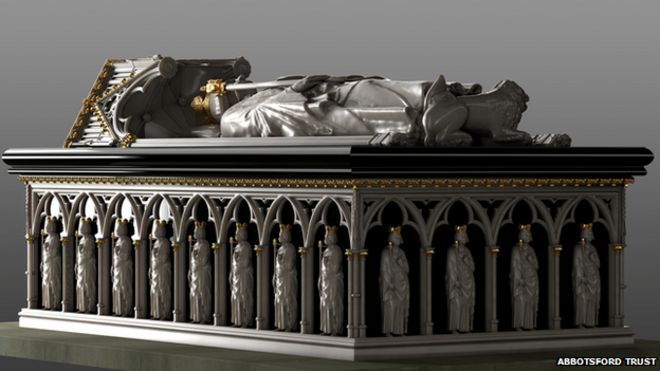
The digital reconstruction of Robert the Bruce's tomb 
Abbotsford has been open to the public following a major restoration project for almost two years now, so you might be wondering 'why start a blog now?' Well, this week seems like a particularly good time to start sharing our stories as we celebrate the opening of our new 2015 exhibition: 'The Lost Tomb of Robert the Bruce.' This exhibition is the fruit of our first collaborative project with a number of other Scottish heritage bodies, making sharing new ideas and research something that is right at the forefront of our minds. Now, of course, it is our aim that readers will come to the house and see the display for themselves so don't expect to read too many exhibition spoilers here! What I do want to discuss is why I think Scott would have been pleased as punch to have the remaining fragments of the Bruce's tomb here in his beloved home, particularly as so many of the other fragments are far more ornate that the one he managed to acquire!

The remaining medieval marble fragments found when work was beginning on building the new parish kirk at Dunfermline in 1818 


Scott and the Bruce


Now, considering his penchant for augmenting history with myth, particularly with regard to reimagining the past of his native Scotland, it will come and no surprise that King Robert I fascinated Scott. 2015 is actually the bicentenary of The Lord of the Isles, one of his final poetical works and one that focuses on the exploits of the exiled Bruce in the seven years leading up to the famous victory at Bannockburn. Not only do we now know that he managed to acquire a piece of the Bruce's impressive marble tomb long since destroyed, but he also proudly displayed a cast of the monarch's skull here at Abbotsford. We know that the original cast of the skull was made by the sculptor, William Scoular, following the exhumation of what was believed to be the King's remains in 1818 whilst building work was going on at Dunfermline Abbey. This cast is now kept in the Anatomy Department of the University of Edinburgh and we know that further casts were taken from this original, one of which proved irresistible to the magpie eye of Sir Walter Scott.


Scott's Cast of the Bruce's Skull
Another rather fun fact is that Scott also seems to have had a hand in bringing that famous scene of the industrious spider inspiring the downtrodden king into the popular consciousness, along with the sentiment of the popular expression 'if at first you don't succeed, try, try again.' The spider story appears in Tales of a Grandfather,written primarily for his beloved six year-old grandson, John Hugh Lockhart and published in 1828:

    "Bruce, seeing the success of the spider, resolved to try his own fortune; and as he had never before gained a victory, so he never afterwards sustained any considerable check or defeat. I have often met with people of the name Bruce, so completely persuaded of the truth of this story, that they would not on any account kill a spider; because it was that insect which had shown the example of perseverance, and given a signal of good luck, to their great namesake." 
Although this was the first time this parable of perseverance had entered the public sphere in any major way, the first reference to this small arachnid catalysing events in Scotland's history is buried in an account by David Hume of the exploits of the 'Black' Douglas, Bruce's ally. Now it turns out that Scott has a 1644 edition of this particular book in his library here at Abbotsford: The history of the house and race of Douglas and Angus written by Mr. David Hume of Godscroft , along with a host of other antiquarian historical books on the subject, so we can be pretty sure of where his inspiration for the moral lesson came from! 

Throughout Scott's writings you get the sense that he was captivated by the romanticised outlaws of the past and he collected items connected with them, sometimes very spuriously, as if they were magical amulets or totems. As Scotland's most famous warrior king, the tomb fragment is one of the most powerful example of this activity in relation to a monarch and I am positive that the great man himself would be thrilled to see the remaining fragments on public display together; sadly all that now remains of a once grand medieval monument to rival the French tombs of old. 

You can visit 'The Lost Tomb of Robert the Bruce' free of charge with a house admission ticket until November 30th 2015.  To find out more about visiting us, click here.

Thanks for reading!

Kirsty Archer-Thompson 
Heritage and Engagement Manager