Abbotsford Entrance Hall

Abbotsford Entrance Hall
Showing posts with label Archaeology. Show all posts

Tuesday, 14 July 2015

The Ground Beneath Our Feet


Well the 25th national Festival of Archaeology is just getting underway, so it got me thinking about a side of Scott's antiquarian pursuits that perhaps doesn't get as much coverage as it should: his interest in what we know today as archaeology and the early evolution of this discipline. 


The area around Abbotsford is extraordinarily rich in archaeology, with over sixty scheduled monuments/sites recorded within a 10km radius of the house. This tangible evidence of the past did not escape Scott's attention. In fact, it may well have drawn him to the landscape of Cartly Hole Farm in the first place as he recalled childhood memories of visiting the Turn-again stone with his father, a 'rude stone' marking the spot where the retreating followers of Buccleuch killed the persuing Kerr of Cessford in 1526. As the Abbotsford estate started to take shape and the years went by, Scott was proud to own the land that, amongst other things, encompassed the site of the Battle of Melrose, ''the last great battle of the Borders;'' a section of the old Roman road running from the camp on the Eildon hills to the ford of the Tweed after which Scott named his new home, and two Iron-age hill forts at Castlesteads and Huntlyburn. He also acquired Rhymer's Glen, a site powerfully associated with folklore traditions of the area. 


Section of the 1838 estate map showing the Castlesteads site 

Scott was a child of the Enlightenment and this movement spurred on a desire to understand and document the past in a more comprehensive manner. National and imperial agendas were rife as institutions and societies sought to amass impressive collections of exotic artefacts and curiosities to compete with one another. Excavations in the Middle East, Egypt and the heartlands of Roman Europe yielded up treasures that, for the most part, ended up very far from home. Remember that the silver urn given to Scott by Lord Byron in 1815 contained ‘bones found in certain ancient sepulchres within the land walls of Athens.' During Scott's lifetime, the importance of object association and stratigraphy (the study of layered deposits beneath the ground that reflect periods of human activity), was just beginning to capture the proto-archaeologist's imagination. Having said that, it was not until shortly after Scott's death that antiquarians started to understand that finds could be ordered chronologically by using this technique. 


The Egyptian Expedition under the orders of Napoleon Bonaparte, painted by Léon Cogniet. This painting shows a key element of the expedition 1798-1801: the very first overseas archaeological excavation conducted by scientific experts of the day.
In Scott's library, you will find early works such as 'Archaeologica Britannica,' published in 1707. There are also a fair few accounts of funerary monuments and sepulchral remains in churches and graveyards across Britain, a dissertation on the Roman tombs of Great Britain, and several of Sir Robert Sibbald's works on the antiquarian sites of Scotland (Sibbald was once Geographer Royal of Scotland). This was a time when 'archaeology' and 'antiquarian' were terms that could just as easily refer to philological study, and certainly there are many more books in Scott's library that explore the languages of past peoples, particularly those of the Britons. Etymologically, archaeology didn't acquire it's association with scientific study until the mid-1820s. Until that point, it had simply denoted the study of the ancient world. 
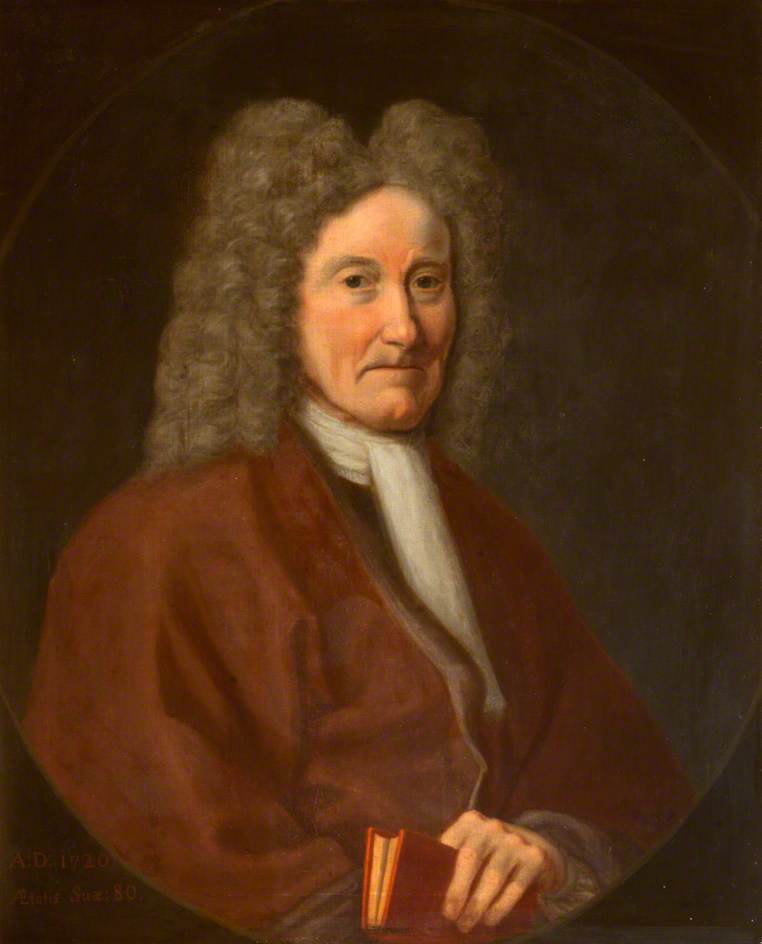
 Sir Robert Sibbald (1641–1722), Physician, Antiquary and Geographer

At Abbotsford there isn't a great deal of archaeological material on display. The wonderful Tors Chamfrein discussed in my last post is probably our key piece, on show in the Ante Room alongside a brass pot and hexagonal cup reputedly found in the ruins of Graham's Dyke near Kirkintilloch, the site of a Roman Fort situated on the Antonine Wall, on the 14th April 1822. 

In our collections stores we have a handful of pottery sherds, an ossuary urn, fragments of timber from Birdoswald Camp on Hadrian's Wall, and two Roman oil lamps. However, if you look outside it is a very different story. The niches of the South Court yield up some archaeological joys and were actually designed specifically to display this material. Five sculpted stone altars to the gods Jupiter, Apollo, Mars, Mercury and Venus set in these niches actually come from the Roman fort of Voreda at Old Penrith. 
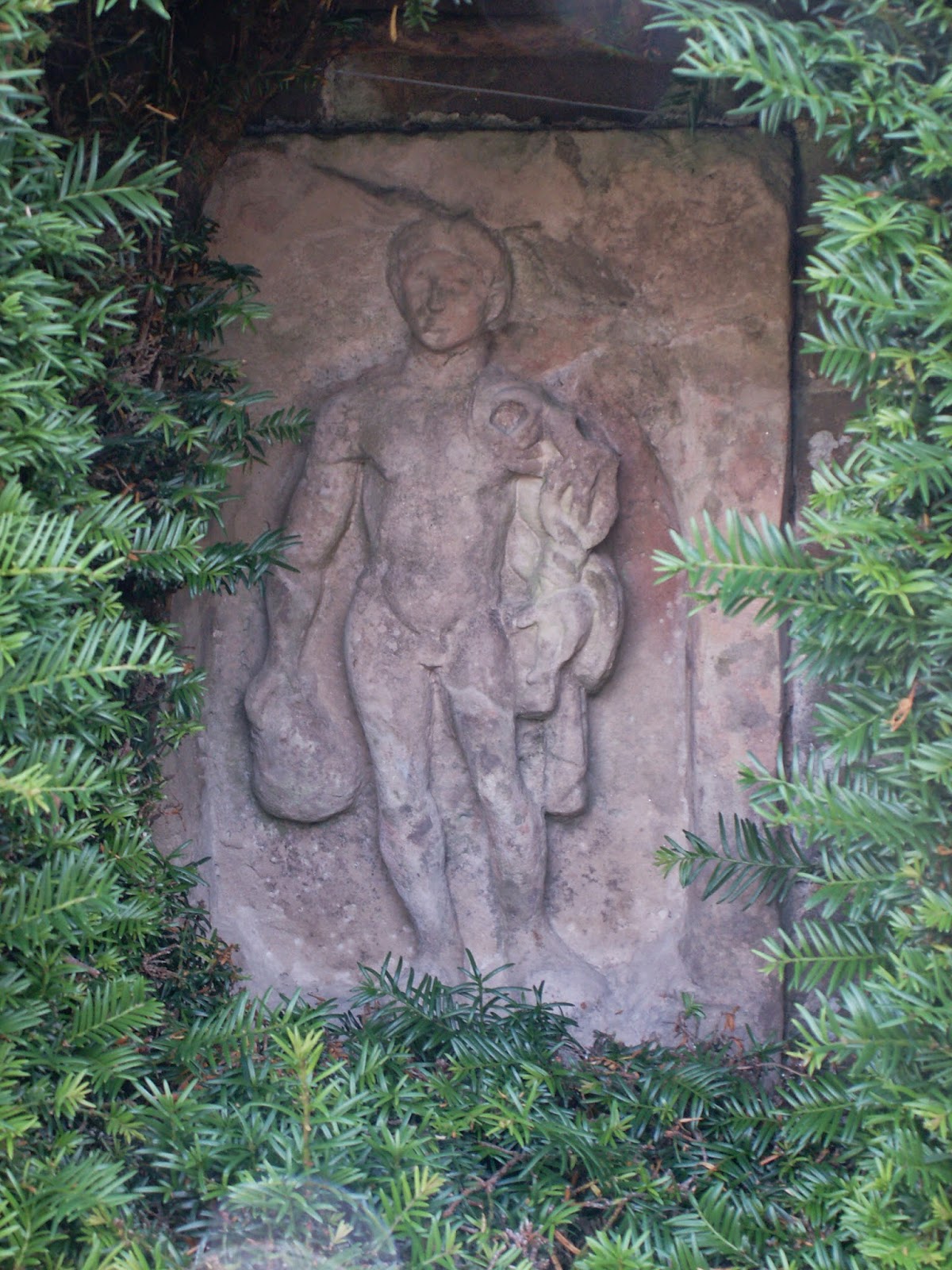
Altar to Mars, God of War, in the Abbotsford South Court
Chancellor Richard Ferguson, the President of the Cumberland and Westmorland Antiquarian Society (founded in the Victorian period), understood how much Voreda had captured Scott's imagination, claiming that the writer “ had made it a practice never to go south without stopping at it and meditating upon it.” Indeed Sir Walter’s journal entry of April 4 1828 mentions that “in our stage to Penrith I introduced Anne to the ancient Petreia, called Old Penrith.” Now, whether you agree with the circumstances in which Walter acquired such treasures or not, it is somewhat of a relief that the altars have been displayed together as a group - albeit interspersed with roundels from the Mercat Cross! Another inscribed stone in the South Court was carved by a detachment of a legion active 'between the walls'. At first this inscription was thought to come from Voreda, but, much like the brass pots, it may in fact hail from the Antonine Wall area. If the tiny figure outside of the border is interpreted as a depiction of Capricorn, it provides valuable information on the movements of the Twenty-second 'Primigenia' Legion, who used it as one of their symbols.

I thought I'd finish with a wonderful excerpt from the American author Washington's Irving's account of visiting the Abbotsford estate.  

'In the course of our morning's walk, we stopped at a small house belonging to one of the labourers on the estate. The object of Scott's visit was to inspect a relic which had been digged up at the Roman camp; and which, if I recollect right, he pronounced to have been a tongs...As he stood regarding the relic, turning it round and round, and making comments upon it, half grave, half comic, with the cottage group all around him...I seemed to see before me that prince of antiquarians and humorists, holding forth to his unlearned and unbelieving neighbours.'  

I hope you've enjoyed reading about a few of our true antiquities today. 
  
Thanks for joining us!

Kirsty Archer-Thompson
Heritage and Engagement Manager

Wednesday, 17 June 2015

Field Marshal Blücher's Tiny Teapot and Other Adventures...


Earlier this week, our volunteers were treated to a trip up to the National Museum of Scotland in Edinburgh. As with all staff get-togethers, it was long overdue and offered a rare opportunity for volunteers based in different areas to meet one another properly and have some fun!

Of course, this was a cultural outing and it was my mission to put together an itinerary that had some relevance to Scott. With a sprinkling of fairydust from external funders, we can ensure that this is the first of a series of excursions that will help our volunteers make associations and connections with other historical sites, people in history and major events that shaped Scott's worldview.

Perhaps no event is more significant in Scott's lifetime than the battle of Waterloo, especially when you consider it is the culmination of a pervading mood of fear and hostility that had been simmering away in Britain ever since the French Revolution, at least amongst the conservative faction. Now, I shan't harp on about Waterloo again after such a recent blog post on the subject (even if it is tempting within a whisker of the bicentenary itself), but I would like to draw attention to the first pitstop on our Scott-themed tour of NMS: an excellent little exhibition entitled 'Waterloo: After the Battle,' curated by Dr. Stuart Allan.

Our Volunteers Malcolm and Will putting Dr Allan through his paces

We were lucky enough to have Dr. Allan show us around the displays which really helped to bring everything to life. Perhaps most poignant for the Abbotsford troupe was the chance to see the captured bronze eagle of the French 45th Infantry, one of two Napoleonic totems taken by the British forces during the battle. 


The Eagle of the 45th

Why is it relevant to Scott? Well, we have an eagle at Abbotsford, albeit something a little less 'shiny...' For some time it was rumoured that this was the real deal, until it was pointed out that the whereabouts of the two captured imperial eagles was already known! Our wooden version is, we think, more likely to be a stage prop that accompanies a set of flags we have in the archives, one of which is a replica standard of the French 105th Infantry, the other regiment to lose its colours on the 18th June.  Other artfefacts on display in this exhibition included Napoleon's sugar bowl, part of a wonderfully ornate tea service (which I am sure Scott would have moved heaven and earth to get hold of if he could have done), commemorative Black Watch pottery fired in 1816, and my personal favourite: a tiny little silver teapot that supposedly belonged to Field Marshal Blücher, the septuagenarian commander of the Prussian forces. I guess he wasn't quite as butch as history would have you believe!

It appears the Prussians also marched on tea.

Wonderful rustic Scottish pottery from Portobello
After wolfing down a tasty lunch, we were treated to a fantastic tour of the Scottish galleries with George Dalgleish, Keeper of Scottish History and Archaeology. George is an Abbotsford Trustee and as such, he was able to give us a fantastic overview of the objects in the museum collection that Scott had owned, written about and seen exhibited. One of the real treasures of Abbotsford, the Torrs Chamfrein, actually resides at the National Museum after it was sold decades ago by Scott's descendents to avert ever-present financial difficulties. Luckily, the museum provided us with their Victorian replica of the artefact at the time of that transaction so visitors can still see a version of the piece in its rightful setting here at Abbotsford.


The Torrs Chamfrein at NMS, once belonging to Sir Walter Scott

Chamfreins, being ceremonial or armoured headpieces for horses, are interesting things and this one in particular is a bit of a conundrum.  There are fine examples from Roman Britain in other institutions, but this Iron Age example, dated to approximately 200BC is more likely to have been ritual in function. Whether it was made for animal or human is very much open to debate; perhaps in a shamanistic ceremony it transformed an individual from one thing to another. The pony cap and horns were unearthed in a peat bog at Torrs Farm in Dumfries and Galloway in the 1820s and given to Scott as a curiousity worthy of his 'museum for living in'. Having been found initially as two separate items in the same location, it is unclear how the cap and horns marry together both physically and chronologically but they have been displayed as one piece for some time now. Until new research can find a way to navigate the minefield of 'cult archaeology', the enigma of the Torrs chamfrein continues. 

Passing through the medieval gallery, we caught a glimpse of the famous Lewis chessmen. We were all surprised to find that Scott narrowly missed out on acquiring these, in reality due to his ailing health.


A Selection of the Lewis Chessmen
An Edinburgh Antiques dealer had put his collection of chesspieces up for the consideration of the Keeper of Manuscripts at the British Museum on the 17th October 1831 and Sir Walter Scott happened to see the relics, being present to consult manuscripts for research purposes. His journal entry that day is as follows: 'the morning beautiful today, I go to look after the transcripts in the Museum and leave a card on a set of chess men thrown up by the sea on the coast of Scotland which were offered for £100.' As the twists and turns of fate would have it, it was actually his friend Charles Kirkpatrick-Sharpe who ended up owning eleven pieces of the much larger collection. I wonder how different things would have been if he hadn't been so unwell at the time and what a joy the chesspieces would have been to have at Abbotsford!

After having wended our way past the towering Scottish Maiden, a guillotine that features in Scott's novel The Abbot, the final highlight of our tour (and there were many more than I can possibly cover here) was seeing the sporran that inspired that famous passage in Rob Roy:
 "I advise no man to attempt opening this sporran till he has my secret,'' said Rob Roy; and then twisting one button in one direction, and another in another, pulling one stud upward, and pressing another downward, the mouth of the purse, which was bound with massive silver plate, opened and gave admittance to his hand. He made me remark, as if to break short the subject on which Bailie Jarvie had spoken, that a small steel pistol was concealed within the purse, the trigger of which was connected with the mounting, and made part of the machinery, so that the weapon would certainly be discharged, and in all probability its contents lodged in the person of any one, who, being unacquainted with the secret, should tamper with the lock which secured his treasure."
 
Gentlemen, beware! Sporran clasp concealing two small steel pistols


Some cautionary tales around the Scotch Maiden

 Now, as with all items that occupy that murky border country between history and myth, this NMS item is popularly referred to as Rob Roy's sporran, and indeed it must have inspired that passage in the novel, but there is no evidence whatsoever that it ever belonged to the folk hero. As ever with these things, the popular imagination sides with the storyteller. And isn't it more fun that way? Scott would have most certainly thought so. 

I hope you've enjoyed our little virtual excursion though the National Museum of Scotland. 

Thanks, as ever, for reading!

Kirsty Archer-Thompson
Heritage and Engagement Manager


one button in one direction, another in another…when the mouth of the purse…opened… a small steel pistol was concealed within the mounting,…so that the weapon would be discharged’ - See more at: http://www.26treasures.com/creationstories/sporran-clasp-four-concealed-pistols-stuart-delves#sthash.NiWKwVcx.dpuf