Abbotsford Entrance Hall

Abbotsford Entrance Hall

Sunday, 22 November 2015

Winter is Coming...

As we have a good old British grumble about the first chilly spell of the winter, I couldn't resist naming this post after the famous phrase from George R. R. Martin's epic fantasy series A Song of Ice and Fire, better known to many as Game of Thrones. After all, Martin has claimed that Scott's Waverley Novels, particularly Ivanhoe, had a great influence on his work. But more on this another time...

Ser Loras Tyrell rides in the joust at the Tourney of the Hand in Game of Thrones. The Canadian writer Margaret Atwood refers to the saga that has taken the world by storm as 'Ivanhoe with the rape and gutting scenes included.' Gritty would have been a gentler turn of phrase!

The arrival of winter heralds a time of change for Abbotsford, and oddly it isn't a case of closing everything down at the end of November as our seasonal opening times may suggest. Visitors are still enjoying the house and collections as I sit here typing this and it couldn't be a more beautiful example of a crisp and still winter's day, but underneath the calm water we are paddling away ferociously!

A lot of people approach me and ask out of genuine curiosity what goes on here when the house closes to the public, and indeed why it has to close at all. I have no doubt that, although the number of intrepid visitors would be small in the colder months, we will always have people keen to come and explore Abbotsford, no matter what the weather. And so, this post is an attempt to try and explain to those of you that might not know, why so many historic houses tend to close in the winter and what is going on behind those closed shutters. 

Abbotsford with a beautiful dusting of snow last winter

Of course some houses and stately homes are family-owned and close in the winter so that the occupiers can 'reclaim' particular wings or key rooms in the house, particularly as Christmas approaches. With Abbotsford in the hands of a charitable trust, this isn't something we have to worry about, although we do have an 1850s wing of the house dedicated to private holiday accommodation which is open year-round for bookings. Sometimes historic houses close because of the risk posed by adverse weather conditions and the difficulties of ensuring access and safety around the gardens, the approach to the house and even out on the wider estate. This is certainly something we are not immune from here at Abbotsford, even though the site as a whole is more bijoux than many of the other stately homes in the area. Locals will know that the winters in the Borders can be extremely harsh and becoming snowed in in this little riverside hollow is not unheard of!

The primary reason that we close between December 1st-February 29th is in order to conduct an intensive period of museum housekeeping across the interiors of Abbotsford known as 'conservation cleaning'. In a nutshell, this signifies a very different type of cleaning than you or I would conduct in our homes - it isn't a case of applying liberal amounts of elbow grease and coating everything in Brasso and detergents! This approach  is a method of cleaning interiors and artefacts that focuses on non-invasive techniques, thereby protecting vulnerable historic decoration and antiques from harm. This means we always have to steer away from traditional chemical cleaning agents and use an entirely separate kit designated for the Scott-period interiors at Abbotsford. Some examples of the type of things you would find in our kits are: HEPA filter museum vacuums of various sizes complete with specialist attachments, a battalion of brushes with different types of natural bristles, including goat hair and pig hair, deionized water, microcrystalline wax polish, cotton swabs, gauze and an awful lot of powder-free gloves! 
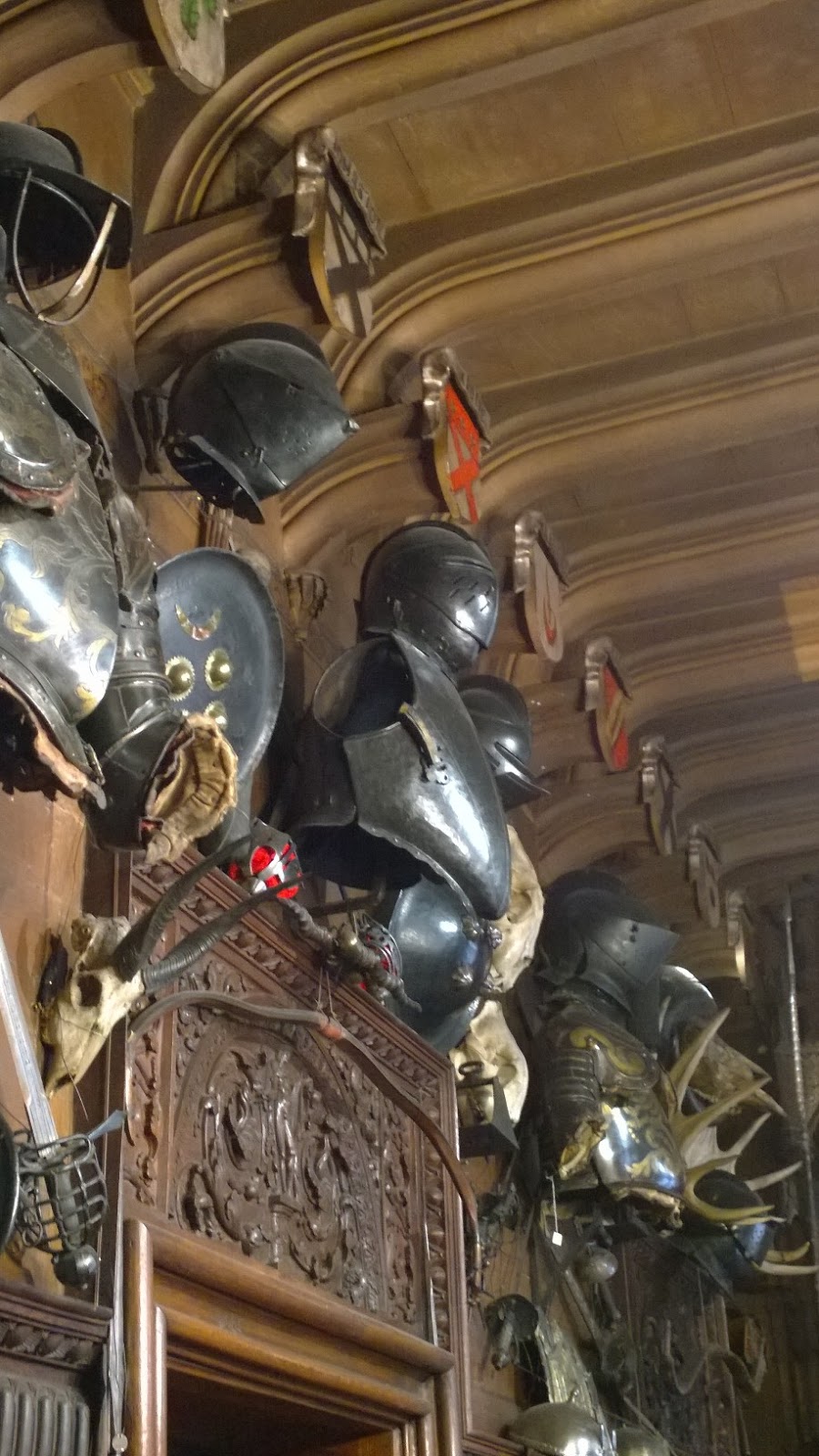
We cannot wait to eliminate the layer of dust that has settled on the tops of the helmets in the Entrance Hall! 

Although our daily housekeeping routines tackle the dust and dirt that can build up around floor and shoulder height, the closure of the house allows us to work through the rooms from ceiling height downwards in a circular motion to ensure that the dust we disturb falls downwards and is removed as we go. One of the main reasons we have so much to do here in the winter months is the sheer amount of material here in Scott's 'museum for living in'.  Put simply, dust has no shortage of surfaces to settle on! Abbotsford's ceilings are not as high as in many other historic houses but reaching the cornicing and the tops of paintings and shelves still requires building the tower scaffolding and using a mid-range platform for cleaning the wall-mounted items. We approach the very high areas on a rotational basis and this year it is the turn of the Chapel and Library, along with the Entrance Hall which always requires cleaning at height due to the position of the room in the house and the array of collections items it contains. 

Tackling the picture frames and the cornicing in the Chinese Drawing Room in February 2015

I'm sure there will be many people out there who are thinking that Scott certainly didn't dangle around at perilous heights cleaning all these artefacts on the walls and that in all probability he wanted it to look dusty and antiquated, and I'm sure there is an element of truth in that, judging from the brief he gave David Ramsay Hay for artificially aging the paintwork in the Entrance Hall. But this isn't about aesthetic principles, although all of the team involved in the closure work would love for their work to be noticed and commented upon; sadly because our work does not make everything gleam, this tends not to be the case! Our main aim is to protect the collections items by eradicating any impacted dust and grime. In our own homes, we may well see a little dust as no harm whatsoever and certainly in museum environments, there are plenty of reasons why you shouldn't over zealously clean surfaces, but in actual fact a buildup of dirt attracts two things that we try and avoid at all costs: moisture, which can be harmful in itself, and insect pests that seek moist environments and live by feeding off the proteins in dust, amongst other foodstuffs. 

One of the joys of conservation cleaning: a different view of something we know so well - Henry Raeburn's 1809 portrait of Scott
When I mention museum vacuums to people, even some of our volunteers, they often give me a  withering look as if they suppose that the prefix 'museum' when used in equipment purchasing has the same effect as the word 'wedding'! In some cases this is most certainly true and you can find fantastic substitutes that are not branded for museum or conservation work for a fraction of the cost, as long as you keep a careful eye on what things are made from. However I think these vacuums are fantastic pieces of kit, offering complete adjustment of suction so that you can hoover carpets and hard floors comprehensively alongside delicate textiles, books, plasterwork and carved wood, all with the same appliance. They come with many fine brushes and nozzles so that you can reach and remove the dirt ingressed around the spines of books and in the crevices of carvings and gilt frames. Not to mention the fact that one of them is a backpack museum vacuum for working at height, affectionately known by our  team as the 'Ghostbuster vac'! When we are using one of the vacuums on delicate objects, particularly books and textiles, we always start on the lowest suction setting and cover the end of the narrow tube with a square of gauze or fine netting secured with a plastic band. This is a method used to examine whether the cleaning is removing more than just dust, such as detached leather fragments or textile threads. If this is the case the item cannot be vacuumed and must be hand brushed or in some cases, left well alone if it is simply too fragile to be handled. 

Our largest Museum vacuum or the 'Ghostbusters Vac'.

The 9,000 or so books in the Abbotsford Library are all hand cleaned over the winter, some using direct appliance of the museum vacuum and others, perhaps of a significant age or with a binding in a state of deterioration, are hand brushed into a box with a hole in the side for the vacuum attachment. This way the dirt is contained and picked up without risking harm to the book. With many of the key insect pests that can cause havoc in museums enjoying devouring a good book, so to speak, this is also the time to visually check each volume and note down alterations in condition or areas of concern. It's a huge task and one in which we have to be extremely careful to preserve the order of Scott's books on the shelves, just as he left them in 1832. This preserved order is of course one of the most famous attributes of the Abbotsford Library. Last year the books took our team just under four weeks to complete and this year we're hoping to beat that record!

One of the trickiest areas for book cleaning is the Study Gallery. 

Of course cleaning isn't the only thing going on here over the next 2-3 months. We are also completing essential maintenance works across the site and planning ahead for the changeover of the Visitor Centre exhibition books in early January. I'm also working on a very exciting project for our new 2016 exhibition in the historic house, launching at the beginning of April. Blog readers will get the first news about this hot off the press in due course...

I shall be photographing our behind the scenes activities over the next few weeks to share with you all in a winter roundup early next year, so do keep checking the Abbotsford Collections blog or sign up for updates to receive a prompt when the next post goes live.          

Thanks for reading and wrap up warm!

Kirsty Archer-Thompson
Collections and Interpretation Manager

Friday, 30 October 2015

Things that go Bump in the Night


‘The ghost nowhere makes his appearance so well as with you.’
So declared the first Englishman to translate Leonore, Gottfried August Bürger’s blood-curdling tale of a bereaved fiancée inadvertently lured to her end by the phantom of her beloved. William Taylor’s praise was directed at the young Walter Scott who had been inspired by Taylor’s work to produce his own translation from the German as soon as he was able to secure a copy of the original text. 

An 1896 Kirchbach illustration of Leonore

The Chase and William and Helen was Scott’s first publication, and how fitting that the subject matter echos the supernatural ballads about fairies, witches and ghosts that he would go on to collect and publish in The Minstrelsy of the Scottish Border, and later invoke in various guises in many of the Waverley Novels. Consider the supernatural tales from the days of the Covenanters ringing in the ears of Jeanie Deans as she clambers up Salisbury Crags to meet Effie’s captor in Heart of Midlothian, or the gypsy incantations and prophecies of Meg Merrilies in Guy Mannering, or the visitations of the spectral White Lady in The Monastery.  

In the bottom right of the illustration is the toadstone amulet at Abbotsford. The stone, thought to grow inside the toad, was believed to ward off evil spirits and protect the vulnerable, particularly infants, from being kidnapped by fairies. 
That Scott had a lifelong passion for the history and evolution of folk beliefs is beyond dispute. The Abbotsford Library contains around 250 works on sorcery, witchcraft and demonology dating from 1477 to 1832, from the infamous witch-hunting manual Malleus maleficarum to Bowdler’s The Devil’s Cloven Foot. His own beliefs are far trickier to pin down. Certainly he is careful not to demonstrate contempt or disregard for belief systems in a post-enlightenment world, and regards the bathos sometimes apparent in the conclusions of Gothic stories as insulting to the reader.    

A stealthy step behind the arras, may doubtless, in some situations, and when the nerves are tuned to a certain pitch, have no small influence upon the imagination; but if the if the conscious listener discovers it to be only the noise made by the cat, the solemnity of the feeling is gone, and the visionary is at once angry with his senses for having been cheated…’
This particular critique appears in his prefatory memoir to the collected works of Ann Radcliffe, one of the most influential early pioneers of Gothic literature. This collection was printed posthumously by Ballantynes in 1824. This castigation seems to be directed as much towards other unnamed writers of the Gothic tradition as to Radcliffe herself, whom Scott believed for the most part to be a ‘genius’ and ‘mistress of her art.’

The novelist Ann Radcliffe
For Scott, musing over the difficulty of concluding a tale of wonder in a way that satisfies the reader, he draws attention to the conundrum facing a writer of supernatural tales: the consumer is always torn between the childlike impulse to account for all unnatural occurrences, and the sheer delight of an enduring mystery, allowing the imagination to explore what remains unsaid. The phrase he uses is beautiful, so much so that it deserves to stand apart. These imaginative revellers are described as:
‘men that walk for pleasure through a moonlight landscape.’

Melrose Abbey by moonlight by J. M. W Turner
So, which appetite did Scott decide to appease in his own ghost story, ‘"The Tapestried Chamber,” one of three short stories in The Keepsake of 1829, a literary annual published for Christmas? You can read the full text of the story here. The appearance of the apparition in the chamber, slowly advancing towards the General’s bed, ghoulishly grinning all the while, really does make your skin crawl. The assessment of the night’s events in the cold light of day is particularly interesting:

Strange as the General's tale was, he spoke with such a deep air of conviction that it cut short all the usual commentaries which are made on such stories. Lord Woodville never once asked him if he was sure he did not dream of the apparition, or suggested any of the possibilities by which it is fashionable to explain supernatural appearances as wild vagaries of the fancy, or deceptions of the optic nerves, On the contrary, he seemed deeply impressed with the truth and reality of what he had heard; and, after a considerable pause regretted, with much appearance of sincerity, that his early friend should in his house have suffered so severely.
Here, there are no aspersions cast on the eyewitness testimony of the General. After subsequently recognising the old hag in a late seventeenth century portrait, we learn that the phantom is a ‘wretched ancestress,’ responsible for ‘infanticide and unnatural murder,’ very much a real entity in all her decomposing glory. I should imagine insomnia would become a common affliction in the Woodville pile after this upsetting turn of events...(!)    

Outwith the literature, there are two tales of supernatural occurrences here at Abbotsford during Scott’s lifetime that are worth exploring in the light of this discussion. The first is relatively well-known and goes some way to explaining why Abbotsford often sneaks on to the lower rungs of the ‘most haunted’ lists in Scotland.


In April 1818, work was still underway with the first extension to the Cartley Hole farmhouse, creating the original Study, Armoury, Dining Room and Conservatory (now lost). The cabinet-maker George Bullock had been engaged to create the fixtures and fittings, and indeed it was Bullock who had persuaded Scott to fit up one of these new rooms as a dedicated Armoury for his ever-growing collection of armour, weaponry and ethnographic objects from around the world. 

Section of the Abbotsford Armoury
On two consecutive nights at the end of April that year, Mr and Mrs Scott were woken at 2am by what sounded like heavy furniture being dragged across the floor in the Armoury below their sleeping quarters. On the second night, Scott crept downstairs, brandishing the Killiecrankie broadsword of his great-grandfather, Beardie, to find nothing amiss. In his letter to Daniel Terry of April 30th, 1818, he recounts events of the nights before and dismisses ghostly interventions in light of the fact that the house is 'exposed' during the period of building work. Scott was as yet unaware that as his letter landed with the Terrys in London, news was breaking of Bullock's sudden death in the early hours of the morning. From this point onwards the presence of the cabinet-maker's spirit at Abbotsford will be felt, making itself heard during periods of renovation and restoration. At least we don't have a malevolent ghost; at least not one that we know of... 

The second incident is related in the memoranda of Mr. J. L Adolphus, English lawyer, author and a friend of Scott, and interestingly it is a story that J. G. Lockhart suggests Scott did not encourage bringing up in conversation. When he does recall the episode of encountering Byron's ghost in the medium of print during the course of his Letters on Demonology and Witchcraft, he uses the thin veil of writing in the third person although the setting is unmistakably Abbotsford: 
 " Not long after the death of a late illustrious poet who had filled, while living, a great station in the eye of the public, a literary friend, to whom the deceased had been well known, was engaged during the darkening twilight of an autumn evening in perusing one of the publications which professed to detail the habits and opinions of the distinguished individual who was now no more. As the reader had enjoyed the intimacy of the deceased to a considerable degree, he was deeply interested in the publication, which contained some particulars relating to himself and other friends. A visitor was sitting in the apartment who was also engaged in reading. Their sitting-room opened into an entrance -hall, rather fantastically fitted up with articles of armour, skins of wild animals, and the like. It was when laying down his book, and passing into this hall, through which the moon was beginning to shine, that the individual of whom I speak saw, right before him, and in a standing posture, the exact representation of his departed friend, whose recollection had been so strongly brought to his imagination. He stopped for a single moment, so as to notice the wonderful accuracy with which fancy had impressed upon the bodily eye the peculiarities of dress and posture of the illustrious poet. Sensible, however, of the delusion, he felt no sentiment save that of wonder at the extraordinary accuracy of the resemblance, and stepped onwards towards the figure, which resolved itself, as he approached, into the various materials of which it was composed. These were merely a screen, occupied by great-coats, shawls, plaids, and such other articles as usually are found in a country entrance-hall. The spectator returned to the spot from which he had seen the illusion, and endeavoured with all his power to recall the image which had been so singularly vivid. But this was beyond his capacity ; and the person who had witnessed the apparition, or, more properly, whose excited state had been the means of raising it, had only to return into the apartment, and tell his young friend under what a striking hallucination he had for a moment laboured." 
Portrait of Lord Byron. He died in 1824 aged only 36, probably of septicaemia.
The rationale here is that the phantom is nothing more than a figment of the imagination, summoned up through our very own literary's friend's choice of highly suggestive reading material on that dusky autumnal evening. Scott was no stranger to the concept of optical illusion and will discuss this at length elsewhere in the Letters, his rational study of the occult published in 1831.  He was an associate and neighbour of Sir David Brewster, author of Letters on Natural Magic, a treatise on how science had been manipulated by religious and political authorities to delude and scaremonger.


Brewster was also the inventor of the kaleidoscope and an authority on the trickeries possible through light and false perspective. However, the eyes remain easier to trick than the ears. I wonder if Scott attributed the same rational explanation to the hammering and thumping he heard during the witching hour of April 28th and 29th 1818. Something tells me otherwise...

I hope you all have a thoroughly horrible Hallowe'en. 

Thanks for reading!

Kirsty Archer-Thompson
Collections and Interpretation Manager


Monday, 21 September 2015

Restoring a Great Unknown


"We laid her there, the Minstrel's darling child"...

This blog post supports the monument campaign of the Edinburgh Sir Walter Scott Club. 

On the anniversary of Scott’s death, it feels like the right time to explore one of the key concerns he had regarding his legacy - the fate of his children. It is well documented that Scott died attempting to pay off the massive debts he was saddled with following the collapse of the publishing firms he had invested in. His creditors were finally appeased on 2nd February 1833, a mere six months after his death. The price of this settlement was high, sacrificing the profits accrued from the sale of all his copyrighted material.  It is less well known however, that as his health failed Scott grew increasingly anxious about the fate of his four children after his death, especially his younger daughter Anne, who had stayed at home unmarried in order to look after him following the death of her mother in 1826. Anne's devotion to her father is captured strikingly in Allan’s 1834 painting ‘The Orphan,’ now owned by the Royal Collection and held at the Palace of Holyrood House

'The Orphan by Sir William Allan

Although the Trust set up for the benefit of his creditors claimed most of his literary earnings, the income from his court salary, his journalistic work and the proceeds of some of his other writing, such as the Tales of a Grandfather series, were his own. Thus, Scott divided his time accordingly, redoubling his literary output in an attempt to repay his debts and provide a legacy for his children.
Sadly none of his family survived long enough to enjoy their inheritance. His much-loved grandson, Little Johnnie, for whom he wrote Tales of a Grandfather, predeceased him by eight months: ‘The boy is gone who we have made so much of’, as Scott wrote from Naples in his Journal; Anne Scott died in June 1833 of a ‘brain fever’, just nine months after her father; Sophia, his eldest child, in May 1837 aged only 38; Charles in 1841 and Walter in 1847. Inheritance through the female line is a recurring feature of the family’s fortunes down the years. 

A portrait of Mr and Mrs Lockhart painted after Sophia's death in 1837. The prominence given to Sophia's wedding ring suggests the portrait is intended to commemorate their marriage. This portrait is the property of the Scottish National Portrait Gallery.

Following her father’s death, Scott's youngest daughter Anne moved to 24 Sussex Place in Regents Park, London, to live with her sister Sophia and brother-in-law John Gibson Lockhart, who had relocated to London from Scotland after becoming editor of the Quarterly Review in 1825. Together, the sisters worked on collating material for Lockhart’s Life of Scott, published in 1839. 


Sussex Place, Regents Park, overlooking the boating lake c.1827

 Both daughters died in London, and were buried in Kensal Green Cemetery, the ‘New Cemetery in the Harrow Road,’ together with Sophia’s son, John Hugh Lockhart. Sophia’s burial service was presided over by the Very Reverand Henry Hart Milman, an historian and dramatist in his spare moments and a friend of the Scott family. So moved was he by observing the mourners that day that he penned some verses to commemorate the event. On hearing the auspicious song of a lark, this particular stanza references Sophia’s spiritual home in the Borders:

We laid her there, the Minstrel's darling child.
Seem'd it then meet that, borne away
From the close city's dubious day.
Her dirge should be thy native woodnote wild ;
Nurs'd upon nature's lap, her sleep
Should be where birds may sing, and dewy flowerets weep?

Worn inscription of the grave in Kensal Green. You can just make out the names of Charlotte Sophia Lockhart (known as Sophia) and her son,  John Hugh Lockhart.

Sophia and Anne’s forgotten monument  was discovered a few years ago by a volunteer researching on behalf of Abbotsford. It is dirty, uneven, overgrown, and the inscriptions are almost illegible, bearing almost no resemblance to the graves of Sir Walter Scott, his wife Charlotte Scott, and J. G. Lockhart, buried in the north transept (or St. Mary’s Aisle) of Dryburgh Abbey. 
 
The north transept of Dryburgh Abbey
The graves of Sir Walter Scott, first baronet, and his eldest son, also Sir Walter, Lieutenant-Colonel in the Fifteenth Hussars. The commemorative stone in the foreground was erected by his son's widow, Jane Jobson. 

Lockhart died at Abbotsford in 1854 in the care of his daughter, now Mrs Charlotte Hope-Scott. This goes some way to explaining why this loving husband and wife were buried 350 miles apart even though six plots had been purchased by Lockhart at Kensal Green, presumably so that his family could be together in death. Kensal Green was consecrated in 1833, so the bodies of Anne and little Johnnie were buried prior to the purchase of the plot and were consequently exhumed and reburied with Sophia. Sophia and her little boy actually share the same grave.   

Falling into disrepair - the Kensal Green grave monument
Scott would surely be saddened if he could see the dilapidated and forgotten Kensal Green graves today. It is estimated that a mere £2,449 could help restore the monument to its former glory. If you would like to help restore the memory and legacy of Sophia, Anne and Scott’s beloved grandson, 'Hugh Littlejohn Esq', please contact hontreas@walterscottclub.org.uk

Thanks for reading!

Kirsty Archer-Thompson
Collections and Interpretation Manager


Saturday, 15 August 2015

A Birthday to Remember

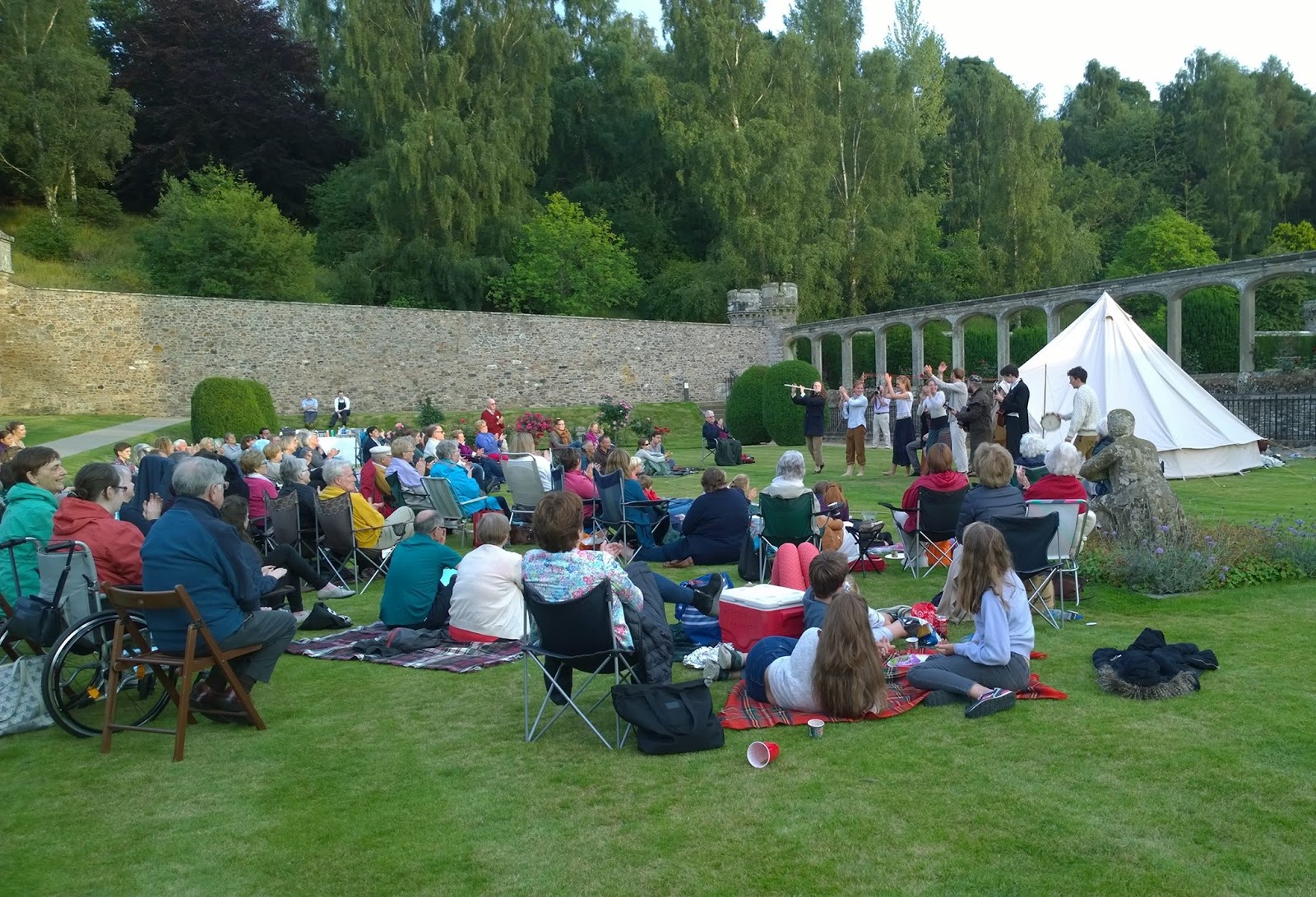
There is always a buzz amongst staff and volunteers at Abbotsford on Scott's birthday. It's a particularly beautiful day today, and, having just hosted a wonderful outdoor theatre performance of Shakespeare's The Tempest in his honour, we're now poised to welcome archers, re-enactors and visitors for all manner of family fun at the annual Abbotsford Arrow tomorrow.

The Tempest in the Sunken or 'Morris' Garden
 In the mist of all of this celebratory activity, I stopped to look through the journal and see if Scott ever acknowledged his own birthday. I had a suspicion that he wouldn't, as squirreled away in our collection stores, we have a wonderful little notebook where Scott actually notes down the birthdays of his children and close relations (including, poignantly, the nameless infant who did not survive). With delicious eccentricity, he duly adds his own name and birthday to this list, as if it might easily slip his mind! Leafing through the journal, he is almost always writing on his birthday in these later years, which, considering his literary output and the financial challenge he faced, isn't surprising. In August 1826, he spends the 15th beavering away writing portions of The Life of Napoleon Bonaparte and Chronicles of the Canongate and suffering from 'oppression' of the chest, proclaiming:
I will never relax my labour in these affairs either for fear of pain or love of life. I will die a free man if hard working will do it.
As far as birthdays go, this day of toil, anxiety and palpitations probably wasn't a particularly pleasant one. However, in 1822, the situation was somewhat different. By this time, Scott had become much more than just a writer; he was a phenomenon, a man that seems to encapsulate the essence of Scotland and speak on her behalf.

The day before his birthday that auspicious year, Scott had famously been branded by King George IV as 'the man in Scotland I most wished to see,' on the deck of the HMS Royal George in the driving rain. The arrival of this ship marked a momentous occasion for a Scotland still nursing deep wounds stemming from the Jacobite rising - a British monarch was to step on Scottish soil for the first time since 1650. The pressure was on Sir Walter Scott, the nationalist unionist, to heal this rift and banish the bad blood, rekindling a sense of pride in Scottish nationhood. He had only three weeks to plan and stage manage a theatrical spectacle the likes of which Edinburgh had never seen.

The entry of George IV into Edinburgh from the Calton Hill by John Wilson Ewbank.
The 300,000 or so spectators lining the streets of the capital on the 15th August 1822, sporting springs of thistles and heather and clasping St. Andrews crosses, eagerly awaited the progress of the king. This procession from the king's landing to Holyrood Palace took just over two hours and commenced and ended with the firing of a royal salute. Pomp and pageantry was very much the order of the day, with a bonfire on Arthur's seat, presentation of the keys to the city and even the erecting of a large illuminated crown on the chimney of the Edinburgh Gas Works that seemed to float above the building. Once inside the palace, he was presented with the Honours of Scotland, the crown jewels long buried within the vaults of Edinburgh Castle and 'recovered' by our very own Sir Walter Scott in 1818. Then, mid-afternoon, he departed for Dalkeith Palace with a party of Scots Greys to spend the evening as the guest of the young Duke of Buccleuch.

Oil painting of The Regalia of Scotland. Gilt frame with 2 shell decorations, by Andrew Geddes (1783–1844), Scottish portrait painter and etcher.

In this first 24 hours, Sir Walter Scott had achieved a tremendous amount. The king had proclaimed that the crowds represented 'a nation of gentlemen' full of 'patriotism and valour.' Of course, Scott had ensured that all those in proximity to his esteemed guest wore their flower pins and carried their crosses and medals to denote their loyalty to the Hanoverian monarch. That particular day, the king was in naval uniform but he is also famed for sporting rather lurid tartan regalia during the state visit. This choice of clothing was a masterstroke dealt by Scott to re-establish the legitimacy of Highland dress, even if some spectators saw more of the kilt-wearing King than they were intending to!

David Wilkie's portrait of George IV in Highland dress. Wilkie has kindly lengthened the cut of the kilt on the rather portly monarch and removed his infamous pink tights!
As his birthday drew to a close on the 15th August 1822, Scott must have reflected on the first hours the king had spent in Scotland and savoured the success of his rigorous planning (even if the rain had slightly muted the effect of his flaming beacon!). Fast forward to the 29th August after a fortnight of jubilation and the king leaves Scotland armed with a gift from the great writer that really encapsulates all the symbolic and historic threads of a proud nation acknowledging their monarch. This 'compound relic' was a snuff box made from eleven varieties or sources of wood associated with Scottish legends, history, events and song. This little snuff box could be viewed as a symbolic message illustrating how the diverse strands of Scotland's past might be reconciled and brought together in the hands of a just ruler who never dismisses the proud heritage of her people. Talk about loaded gifts!

An example of a Mauchline Ware wooden snuff box, made of segments of wood from ten different trees/woods by Daniel Craig of Helensburgh,the man responsible for making the snuff box gifted to King George IV.
It must have been an electric day, one that propelled Sir Walter Scott and Scotland to the forefront of the British conciousness. So, on that note, a very happy birthday to Sir Walter and thank you for reading.

Kirsty Archer-Thompson
Collections and Interpretation Manager

Tuesday, 14 July 2015

The Ground Beneath Our Feet


Well the 25th national Festival of Archaeology is just getting underway, so it got me thinking about a side of Scott's antiquarian pursuits that perhaps doesn't get as much coverage as it should: his interest in what we know today as archaeology and the early evolution of this discipline. 


The area around Abbotsford is extraordinarily rich in archaeology, with over sixty scheduled monuments/sites recorded within a 10km radius of the house. This tangible evidence of the past did not escape Scott's attention. In fact, it may well have drawn him to the landscape of Cartly Hole Farm in the first place as he recalled childhood memories of visiting the Turn-again stone with his father, a 'rude stone' marking the spot where the retreating followers of Buccleuch killed the persuing Kerr of Cessford in 1526. As the Abbotsford estate started to take shape and the years went by, Scott was proud to own the land that, amongst other things, encompassed the site of the Battle of Melrose, ''the last great battle of the Borders;'' a section of the old Roman road running from the camp on the Eildon hills to the ford of the Tweed after which Scott named his new home, and two Iron-age hill forts at Castlesteads and Huntlyburn. He also acquired Rhymer's Glen, a site powerfully associated with folklore traditions of the area. 


Section of the 1838 estate map showing the Castlesteads site 

Scott was a child of the Enlightenment and this movement spurred on a desire to understand and document the past in a more comprehensive manner. National and imperial agendas were rife as institutions and societies sought to amass impressive collections of exotic artefacts and curiosities to compete with one another. Excavations in the Middle East, Egypt and the heartlands of Roman Europe yielded up treasures that, for the most part, ended up very far from home. Remember that the silver urn given to Scott by Lord Byron in 1815 contained ‘bones found in certain ancient sepulchres within the land walls of Athens.' During Scott's lifetime, the importance of object association and stratigraphy (the study of layered deposits beneath the ground that reflect periods of human activity), was just beginning to capture the proto-archaeologist's imagination. Having said that, it was not until shortly after Scott's death that antiquarians started to understand that finds could be ordered chronologically by using this technique. 


The Egyptian Expedition under the orders of Napoleon Bonaparte, painted by Léon Cogniet. This painting shows a key element of the expedition 1798-1801: the very first overseas archaeological excavation conducted by scientific experts of the day.
In Scott's library, you will find early works such as 'Archaeologica Britannica,' published in 1707. There are also a fair few accounts of funerary monuments and sepulchral remains in churches and graveyards across Britain, a dissertation on the Roman tombs of Great Britain, and several of Sir Robert Sibbald's works on the antiquarian sites of Scotland (Sibbald was once Geographer Royal of Scotland). This was a time when 'archaeology' and 'antiquarian' were terms that could just as easily refer to philological study, and certainly there are many more books in Scott's library that explore the languages of past peoples, particularly those of the Britons. Etymologically, archaeology didn't acquire it's association with scientific study until the mid-1820s. Until that point, it had simply denoted the study of the ancient world. 

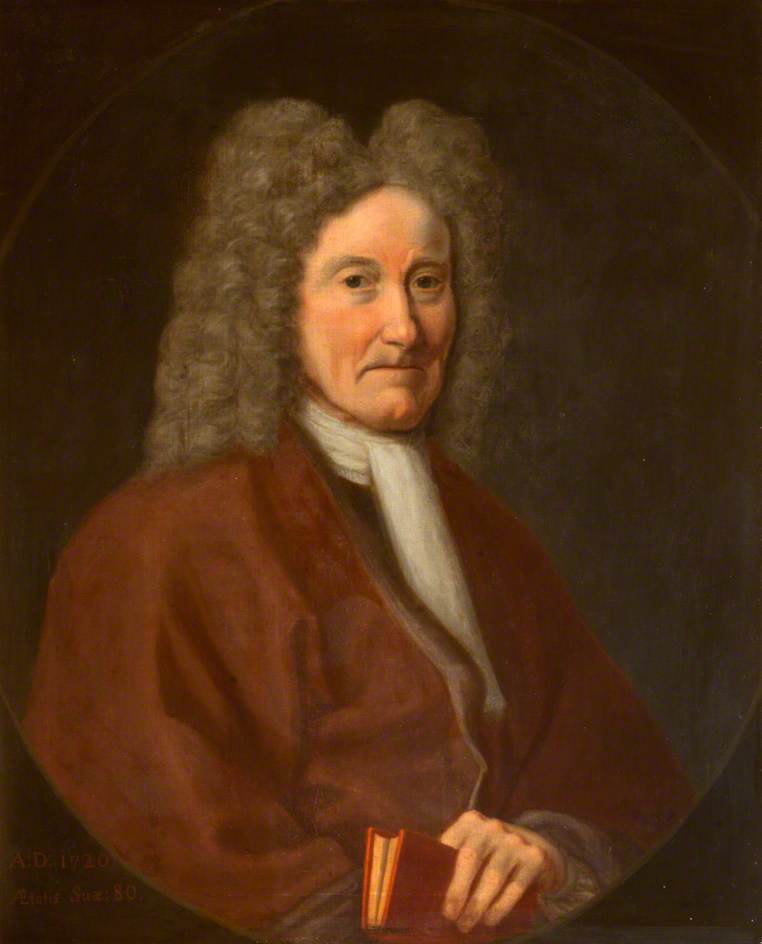
 Sir Robert Sibbald (1641–1722), Physician, Antiquary and Geographer

At Abbotsford there isn't a great deal of archaeological material on display. The wonderful Tors Chamfrein discussed in my last post is probably our key piece, on show in the Ante Room alongside a brass pot and hexagonal cup reputedly found in the ruins of Graham's Dyke near Kirkintilloch, the site of a Roman Fort situated on the Antonine Wall, on the 14th April 1822. 

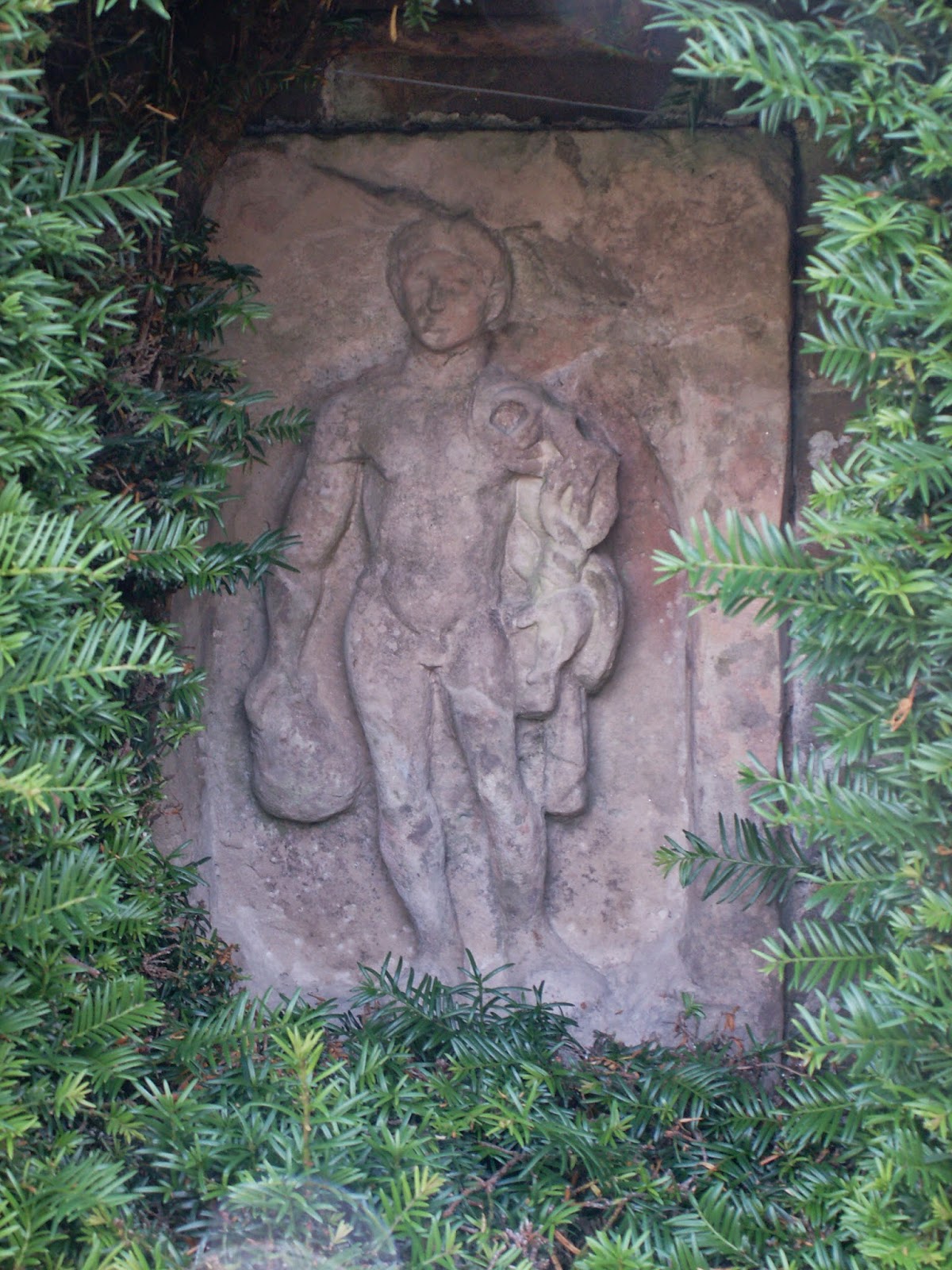
In our collections stores we have a handful of pottery sherds, an ossuary urn, fragments of timber from Birdoswald Camp on Hadrian's Wall, and two Roman oil lamps. However, if you look outside it is a very different story. The niches of the South Court yield up some archaeological joys and were actually designed specifically to display this material. Five sculpted stone altars to the gods Jupiter, Apollo, Mars, Mercury and Venus set in these niches actually come from the Roman fort of Voreda at Old Penrith. 

Altar to Mars, God of War, in the Abbotsford South Court
Chancellor Richard Ferguson, the President of the Cumberland and Westmorland Antiquarian Society (founded in the Victorian period), understood how much Voreda had captured Scott's imagination, claiming that the writer “ had made it a practice never to go south without stopping at it and meditating upon it.” Indeed Sir Walter’s journal entry of April 4 1828 mentions that “in our stage to Penrith I introduced Anne to the ancient Petreia, called Old Penrith.” Now, whether you agree with the circumstances in which Walter acquired such treasures or not, it is somewhat of a relief that the altars have been displayed together as a group - albeit interspersed with roundels from the Mercat Cross! Another inscribed stone in the South Court was carved by a detachment of a legion active 'between the walls'. At first this inscription was thought to come from Voreda, but, much like the brass pots, it may in fact hail from the Antonine Wall area. If the tiny figure outside of the border is interpreted as a depiction of Capricorn, it provides valuable information on the movements of the Twenty-second 'Primigenia' Legion, who used it as one of their symbols.

I thought I'd finish with a wonderful excerpt from the American author Washington's Irving's account of visiting the Abbotsford estate.  

'In the course of our morning's walk, we stopped at a small house belonging to one of the labourers on the estate. The object of Scott's visit was to inspect a relic which had been digged up at the Roman camp; and which, if I recollect right, he pronounced to have been a tongs...As he stood regarding the relic, turning it round and round, and making comments upon it, half grave, half comic, with the cottage group all around him...I seemed to see before me that prince of antiquarians and humorists, holding forth to his unlearned and unbelieving neighbours.'  

I hope you've enjoyed reading about a few of our true antiquities today. 
  
Thanks for joining us!

Kirsty Archer-Thompson
Heritage and Engagement Manager

Wednesday, 17 June 2015

Field Marshal Blücher's Tiny Teapot and Other Adventures...


Earlier this week, our volunteers were treated to a trip up to the National Museum of Scotland in Edinburgh. As with all staff get-togethers, it was long overdue and offered a rare opportunity for volunteers based in different areas to meet one another properly and have some fun!

Of course, this was a cultural outing and it was my mission to put together an itinerary that had some relevance to Scott. With a sprinkling of fairydust from external funders, we can ensure that this is the first of a series of excursions that will help our volunteers make associations and connections with other historical sites, people in history and major events that shaped Scott's worldview.

Perhaps no event is more significant in Scott's lifetime than the battle of Waterloo, especially when you consider it is the culmination of a pervading mood of fear and hostility that had been simmering away in Britain ever since the French Revolution, at least amongst the conservative faction. Now, I shan't harp on about Waterloo again after such a recent blog post on the subject (even if it is tempting within a whisker of the bicentenary itself), but I would like to draw attention to the first pitstop on our Scott-themed tour of NMS: an excellent little exhibition entitled 'Waterloo: After the Battle,' curated by Dr. Stuart Allan.

Our Volunteers Malcolm and Will putting Dr Allan through his paces

We were lucky enough to have Dr. Allan show us around the displays which really helped to bring everything to life. Perhaps most poignant for the Abbotsford troupe was the chance to see the captured bronze eagle of the French 45th Infantry, one of two Napoleonic totems taken by the British forces during the battle. 


The Eagle of the 45th

Why is it relevant to Scott? Well, we have an eagle at Abbotsford, albeit something a little less 'shiny...' For some time it was rumoured that this was the real deal, until it was pointed out that the whereabouts of the two captured imperial eagles was already known! Our wooden version is, we think, more likely to be a stage prop that accompanies a set of flags we have in the archives, one of which is a replica standard of the French 105th Infantry, the other regiment to lose its colours on the 18th June.  Other artfefacts on display in this exhibition included Napoleon's sugar bowl, part of a wonderfully ornate tea service (which I am sure Scott would have moved heaven and earth to get hold of if he could have done), commemorative Black Watch pottery fired in 1816, and my personal favourite: a tiny little silver teapot that supposedly belonged to Field Marshal Blücher, the septuagenarian commander of the Prussian forces. I guess he wasn't quite as butch as history would have you believe!

It appears the Prussians also marched on tea.

Wonderful rustic Scottish pottery from Portobello
After wolfing down a tasty lunch, we were treated to a fantastic tour of the Scottish galleries with George Dalgleish, Keeper of Scottish History and Archaeology. George is an Abbotsford Trustee and as such, he was able to give us a fantastic overview of the objects in the museum collection that Scott had owned, written about and seen exhibited. One of the real treasures of Abbotsford, the Torrs Chamfrein, actually resides at the National Museum after it was sold decades ago by Scott's descendents to avert ever-present financial difficulties. Luckily, the museum provided us with their Victorian replica of the artefact at the time of that transaction so visitors can still see a version of the piece in its rightful setting here at Abbotsford.


The Torrs Chamfrein at NMS, once belonging to Sir Walter Scott

Chamfreins, being ceremonial or armoured headpieces for horses, are interesting things and this one in particular is a bit of a conundrum.  There are fine examples from Roman Britain in other institutions, but this Iron Age example, dated to approximately 200BC is more likely to have been ritual in function. Whether it was made for animal or human is very much open to debate; perhaps in a shamanistic ceremony it transformed an individual from one thing to another. The pony cap and horns were unearthed in a peat bog at Torrs Farm in Dumfries and Galloway in the 1820s and given to Scott as a curiousity worthy of his 'museum for living in'. Having been found initially as two separate items in the same location, it is unclear how the cap and horns marry together both physically and chronologically but they have been displayed as one piece for some time now. Until new research can find a way to navigate the minefield of 'cult archaeology', the enigma of the Torrs chamfrein continues. 

Passing through the medieval gallery, we caught a glimpse of the famous Lewis chessmen. We were all surprised to find that Scott narrowly missed out on acquiring these, in reality due to his ailing health.


A Selection of the Lewis Chessmen
An Edinburgh Antiques dealer had put his collection of chesspieces up for the consideration of the Keeper of Manuscripts at the British Museum on the 17th October 1831 and Sir Walter Scott happened to see the relics, being present to consult manuscripts for research purposes. His journal entry that day is as follows: 'the morning beautiful today, I go to look after the transcripts in the Museum and leave a card on a set of chess men thrown up by the sea on the coast of Scotland which were offered for £100.' As the twists and turns of fate would have it, it was actually his friend Charles Kirkpatrick-Sharpe who ended up owning eleven pieces of the much larger collection. I wonder how different things would have been if he hadn't been so unwell at the time and what a joy the chesspieces would have been to have at Abbotsford!

After having wended our way past the towering Scottish Maiden, a guillotine that features in Scott's novel The Abbot, the final highlight of our tour (and there were many more than I can possibly cover here) was seeing the sporran that inspired that famous passage in Rob Roy:
 "I advise no man to attempt opening this sporran till he has my secret,'' said Rob Roy; and then twisting one button in one direction, and another in another, pulling one stud upward, and pressing another downward, the mouth of the purse, which was bound with massive silver plate, opened and gave admittance to his hand. He made me remark, as if to break short the subject on which Bailie Jarvie had spoken, that a small steel pistol was concealed within the purse, the trigger of which was connected with the mounting, and made part of the machinery, so that the weapon would certainly be discharged, and in all probability its contents lodged in the person of any one, who, being unacquainted with the secret, should tamper with the lock which secured his treasure."
 
Gentlemen, beware! Sporran clasp concealing two small steel pistols


Some cautionary tales around the Scotch Maiden

 Now, as with all items that occupy that murky border country between history and myth, this NMS item is popularly referred to as Rob Roy's sporran, and indeed it must have inspired that passage in the novel, but there is no evidence whatsoever that it ever belonged to the folk hero. As ever with these things, the popular imagination sides with the storyteller. And isn't it more fun that way? Scott would have most certainly thought so. 

I hope you've enjoyed our little virtual excursion though the National Museum of Scotland. 

Thanks, as ever, for reading!

Kirsty Archer-Thompson
Heritage and Engagement Manager


one button in one direction, another in another…when the mouth of the purse…opened… a small steel pistol was concealed within the mounting,…so that the weapon would be discharged’ - See more at: http://www.26treasures.com/creationstories/sporran-clasp-four-concealed-pistols-stuart-delves#sthash.NiWKwVcx.dpuf