Abbotsford Entrance Hall

Abbotsford Entrance Hall

Monday, 21 September 2015

Restoring a Great Unknown


"We laid her there, the Minstrel's darling child"...

This blog post supports the monument campaign of the Edinburgh Sir Walter Scott Club. 

On the anniversary of Scott’s death, it feels like the right time to explore one of the key concerns he had regarding his legacy - the fate of his children. It is well documented that Scott died attempting to pay off the massive debts he was saddled with following the collapse of the publishing firms he had invested in. His creditors were finally appeased on 2nd February 1833, a mere six months after his death. The price of this settlement was high, sacrificing the profits accrued from the sale of all his copyrighted material.  It is less well known however, that as his health failed Scott grew increasingly anxious about the fate of his four children after his death, especially his younger daughter Anne, who had stayed at home unmarried in order to look after him following the death of her mother in 1826. Anne's devotion to her father is captured strikingly in Allan’s 1834 painting ‘The Orphan,’ now owned by the Royal Collection and held at the Palace of Holyrood House

'The Orphan by Sir William Allan

Although the Trust set up for the benefit of his creditors claimed most of his literary earnings, the income from his court salary, his journalistic work and the proceeds of some of his other writing, such as the Tales of a Grandfather series, were his own. Thus, Scott divided his time accordingly, redoubling his literary output in an attempt to repay his debts and provide a legacy for his children.
Sadly none of his family survived long enough to enjoy their inheritance. His much-loved grandson, Little Johnnie, for whom he wrote Tales of a Grandfather, predeceased him by eight months: ‘The boy is gone who we have made so much of’, as Scott wrote from Naples in his Journal; Anne Scott died in June 1833 of a ‘brain fever’, just nine months after her father; Sophia, his eldest child, in May 1837 aged only 38; Charles in 1841 and Walter in 1847. Inheritance through the female line is a recurring feature of the family’s fortunes down the years. 

A portrait of Mr and Mrs Lockhart painted after Sophia's death in 1837. The prominence given to Sophia's wedding ring suggests the portrait is intended to commemorate their marriage. This portrait is the property of the Scottish National Portrait Gallery.

Following her father’s death, Scott's youngest daughter Anne moved to 24 Sussex Place in Regents Park, London, to live with her sister Sophia and brother-in-law John Gibson Lockhart, who had relocated to London from Scotland after becoming editor of the Quarterly Review in 1825. Together, the sisters worked on collating material for Lockhart’s Life of Scott, published in 1839. 


Sussex Place, Regents Park, overlooking the boating lake c.1827

 Both daughters died in London, and were buried in Kensal Green Cemetery, the ‘New Cemetery in the Harrow Road,’ together with Sophia’s son, John Hugh Lockhart. Sophia’s burial service was presided over by the Very Reverand Henry Hart Milman, an historian and dramatist in his spare moments and a friend of the Scott family. So moved was he by observing the mourners that day that he penned some verses to commemorate the event. On hearing the auspicious song of a lark, this particular stanza references Sophia’s spiritual home in the Borders:

We laid her there, the Minstrel's darling child.
Seem'd it then meet that, borne away
From the close city's dubious day.
Her dirge should be thy native woodnote wild ;
Nurs'd upon nature's lap, her sleep
Should be where birds may sing, and dewy flowerets weep?

Worn inscription of the grave in Kensal Green. You can just make out the names of Charlotte Sophia Lockhart (known as Sophia) and her son,  John Hugh Lockhart.

Sophia and Anne’s forgotten monument  was discovered a few years ago by a volunteer researching on behalf of Abbotsford. It is dirty, uneven, overgrown, and the inscriptions are almost illegible, bearing almost no resemblance to the graves of Sir Walter Scott, his wife Charlotte Scott, and J. G. Lockhart, buried in the north transept (or St. Mary’s Aisle) of Dryburgh Abbey. 
 
The north transept of Dryburgh Abbey
The graves of Sir Walter Scott, first baronet, and his eldest son, also Sir Walter, Lieutenant-Colonel in the Fifteenth Hussars. The commemorative stone in the foreground was erected by his son's widow, Jane Jobson. 

Lockhart died at Abbotsford in 1854 in the care of his daughter, now Mrs Charlotte Hope-Scott. This goes some way to explaining why this loving husband and wife were buried 350 miles apart even though six plots had been purchased by Lockhart at Kensal Green, presumably so that his family could be together in death. Kensal Green was consecrated in 1833, so the bodies of Anne and little Johnnie were buried prior to the purchase of the plot and were consequently exhumed and reburied with Sophia. Sophia and her little boy actually share the same grave.   

Falling into disrepair - the Kensal Green grave monument
Scott would surely be saddened if he could see the dilapidated and forgotten Kensal Green graves today. It is estimated that a mere £2,449 could help restore the monument to its former glory. If you would like to help restore the memory and legacy of Sophia, Anne and Scott’s beloved grandson, 'Hugh Littlejohn Esq', please contact hontreas@walterscottclub.org.uk

Thanks for reading!

Kirsty Archer-Thompson
Collections and Interpretation Manager


Saturday, 15 August 2015

A Birthday to Remember

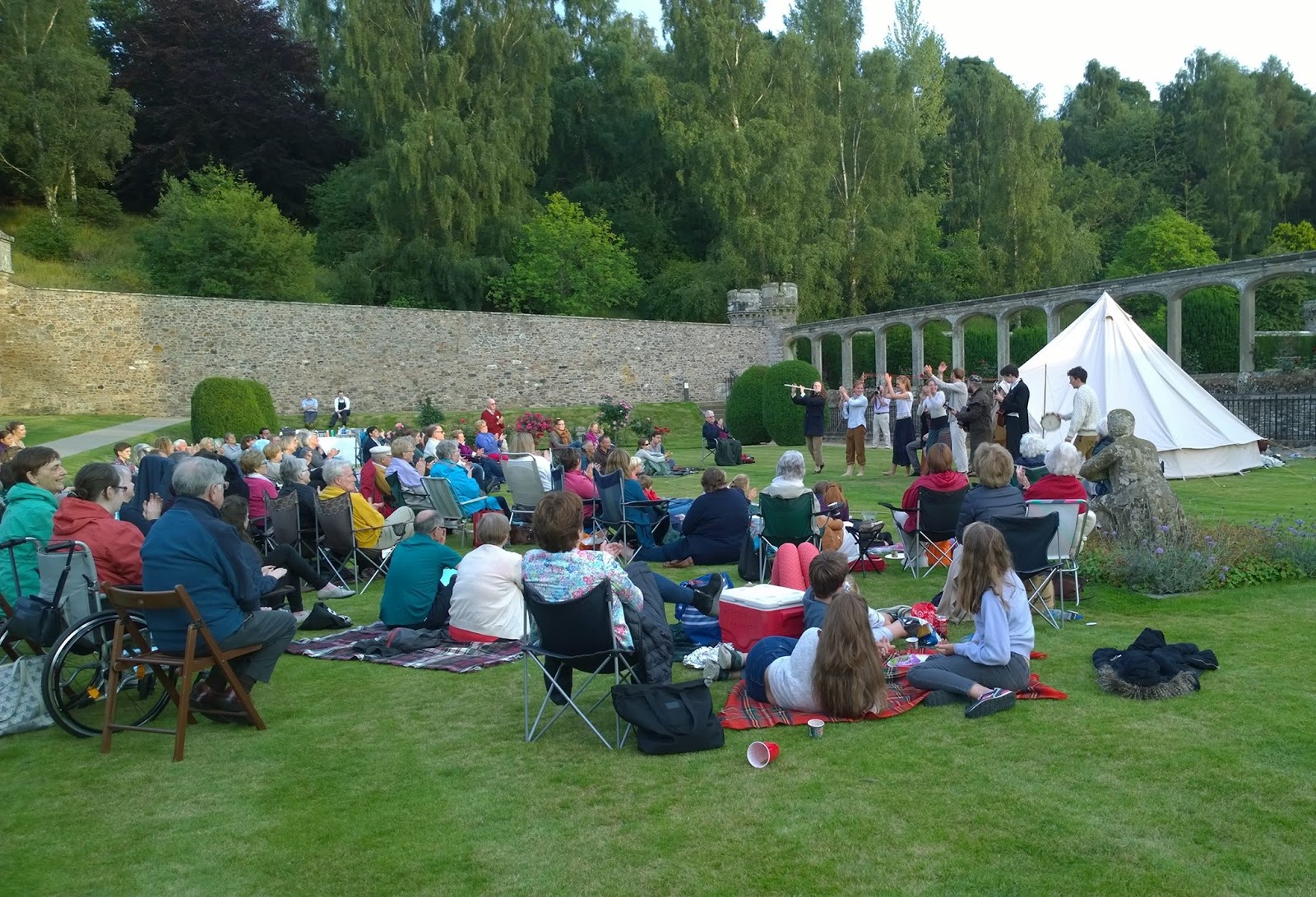
There is always a buzz amongst staff and volunteers at Abbotsford on Scott's birthday. It's a particularly beautiful day today, and, having just hosted a wonderful outdoor theatre performance of Shakespeare's The Tempest in his honour, we're now poised to welcome archers, re-enactors and visitors for all manner of family fun at the annual Abbotsford Arrow tomorrow.

The Tempest in the Sunken or 'Morris' Garden
 In the mist of all of this celebratory activity, I stopped to look through the journal and see if Scott ever acknowledged his own birthday. I had a suspicion that he wouldn't, as squirreled away in our collection stores, we have a wonderful little notebook where Scott actually notes down the birthdays of his children and close relations (including, poignantly, the nameless infant who did not survive). With delicious eccentricity, he duly adds his own name and birthday to this list, as if it might easily slip his mind! Leafing through the journal, he is almost always writing on his birthday in these later years, which, considering his literary output and the financial challenge he faced, isn't surprising. In August 1826, he spends the 15th beavering away writing portions of The Life of Napoleon Bonaparte and Chronicles of the Canongate and suffering from 'oppression' of the chest, proclaiming:
I will never relax my labour in these affairs either for fear of pain or love of life. I will die a free man if hard working will do it.
As far as birthdays go, this day of toil, anxiety and palpitations probably wasn't a particularly pleasant one. However, in 1822, the situation was somewhat different. By this time, Scott had become much more than just a writer; he was a phenomenon, a man that seems to encapsulate the essence of Scotland and speak on her behalf.

The day before his birthday that auspicious year, Scott had famously been branded by King George IV as 'the man in Scotland I most wished to see,' on the deck of the HMS Royal George in the driving rain. The arrival of this ship marked a momentous occasion for a Scotland still nursing deep wounds stemming from the Jacobite rising - a British monarch was to step on Scottish soil for the first time since 1650. The pressure was on Sir Walter Scott, the nationalist unionist, to heal this rift and banish the bad blood, rekindling a sense of pride in Scottish nationhood. He had only three weeks to plan and stage manage a theatrical spectacle the likes of which Edinburgh had never seen.

The entry of George IV into Edinburgh from the Calton Hill by John Wilson Ewbank.
The 300,000 or so spectators lining the streets of the capital on the 15th August 1822, sporting springs of thistles and heather and clasping St. Andrews crosses, eagerly awaited the progress of the king. This procession from the king's landing to Holyrood Palace took just over two hours and commenced and ended with the firing of a royal salute. Pomp and pageantry was very much the order of the day, with a bonfire on Arthur's seat, presentation of the keys to the city and even the erecting of a large illuminated crown on the chimney of the Edinburgh Gas Works that seemed to float above the building. Once inside the palace, he was presented with the Honours of Scotland, the crown jewels long buried within the vaults of Edinburgh Castle and 'recovered' by our very own Sir Walter Scott in 1818. Then, mid-afternoon, he departed for Dalkeith Palace with a party of Scots Greys to spend the evening as the guest of the young Duke of Buccleuch.

Oil painting of The Regalia of Scotland. Gilt frame with 2 shell decorations, by Andrew Geddes (1783–1844), Scottish portrait painter and etcher.

In this first 24 hours, Sir Walter Scott had achieved a tremendous amount. The king had proclaimed that the crowds represented 'a nation of gentlemen' full of 'patriotism and valour.' Of course, Scott had ensured that all those in proximity to his esteemed guest wore their flower pins and carried their crosses and medals to denote their loyalty to the Hanoverian monarch. That particular day, the king was in naval uniform but he is also famed for sporting rather lurid tartan regalia during the state visit. This choice of clothing was a masterstroke dealt by Scott to re-establish the legitimacy of Highland dress, even if some spectators saw more of the kilt-wearing King than they were intending to!

David Wilkie's portrait of George IV in Highland dress. Wilkie has kindly lengthened the cut of the kilt on the rather portly monarch and removed his infamous pink tights!
As his birthday drew to a close on the 15th August 1822, Scott must have reflected on the first hours the king had spent in Scotland and savoured the success of his rigorous planning (even if the rain had slightly muted the effect of his flaming beacon!). Fast forward to the 29th August after a fortnight of jubilation and the king leaves Scotland armed with a gift from the great writer that really encapsulates all the symbolic and historic threads of a proud nation acknowledging their monarch. This 'compound relic' was a snuff box made from eleven varieties or sources of wood associated with Scottish legends, history, events and song. This little snuff box could be viewed as a symbolic message illustrating how the diverse strands of Scotland's past might be reconciled and brought together in the hands of a just ruler who never dismisses the proud heritage of her people. Talk about loaded gifts!

An example of a Mauchline Ware wooden snuff box, made of segments of wood from ten different trees/woods by Daniel Craig of Helensburgh,the man responsible for making the snuff box gifted to King George IV.
It must have been an electric day, one that propelled Sir Walter Scott and Scotland to the forefront of the British conciousness. So, on that note, a very happy birthday to Sir Walter and thank you for reading.

Kirsty Archer-Thompson
Collections and Interpretation Manager
Tuesday, 14 July 2015

The Ground Beneath Our Feet


Well the 25th national Festival of Archaeology is just getting underway, so it got me thinking about a side of Scott's antiquarian pursuits that perhaps doesn't get as much coverage as it should: his interest in what we know today as archaeology and the early evolution of this discipline. 


The area around Abbotsford is extraordinarily rich in archaeology, with over sixty scheduled monuments/sites recorded within a 10km radius of the house. This tangible evidence of the past did not escape Scott's attention. In fact, it may well have drawn him to the landscape of Cartly Hole Farm in the first place as he recalled childhood memories of visiting the Turn-again stone with his father, a 'rude stone' marking the spot where the retreating followers of Buccleuch killed the persuing Kerr of Cessford in 1526. As the Abbotsford estate started to take shape and the years went by, Scott was proud to own the land that, amongst other things, encompassed the site of the Battle of Melrose, ''the last great battle of the Borders;'' a section of the old Roman road running from the camp on the Eildon hills to the ford of the Tweed after which Scott named his new home, and two Iron-age hill forts at Castlesteads and Huntlyburn. He also acquired Rhymer's Glen, a site powerfully associated with folklore traditions of the area. 


Section of the 1838 estate map showing the Castlesteads site 

Scott was a child of the Enlightenment and this movement spurred on a desire to understand and document the past in a more comprehensive manner. National and imperial agendas were rife as institutions and societies sought to amass impressive collections of exotic artefacts and curiosities to compete with one another. Excavations in the Middle East, Egypt and the heartlands of Roman Europe yielded up treasures that, for the most part, ended up very far from home. Remember that the silver urn given to Scott by Lord Byron in 1815 contained ‘bones found in certain ancient sepulchres within the land walls of Athens.' During Scott's lifetime, the importance of object association and stratigraphy (the study of layered deposits beneath the ground that reflect periods of human activity), was just beginning to capture the proto-archaeologist's imagination. Having said that, it was not until shortly after Scott's death that antiquarians started to understand that finds could be ordered chronologically by using this technique. 


The Egyptian Expedition under the orders of Napoleon Bonaparte, painted by Léon Cogniet. This painting shows a key element of the expedition 1798-1801: the very first overseas archaeological excavation conducted by scientific experts of the day.
In Scott's library, you will find early works such as 'Archaeologica Britannica,' published in 1707. There are also a fair few accounts of funerary monuments and sepulchral remains in churches and graveyards across Britain, a dissertation on the Roman tombs of Great Britain, and several of Sir Robert Sibbald's works on the antiquarian sites of Scotland (Sibbald was once Geographer Royal of Scotland). This was a time when 'archaeology' and 'antiquarian' were terms that could just as easily refer to philological study, and certainly there are many more books in Scott's library that explore the languages of past peoples, particularly those of the Britons. Etymologically, archaeology didn't acquire it's association with scientific study until the mid-1820s. Until that point, it had simply denoted the study of the ancient world. 

 Sir Robert Sibbald (1641–1722), Physician, Antiquary and Geographer

At Abbotsford there isn't a great deal of archaeological material on display. The wonderful Tors Chamfrein discussed in my last post is probably our key piece, on show in the Ante Room alongside a brass pot and hexagonal cup reputedly found in the ruins of Graham's Dyke near Kirkintilloch, the site of a Roman Fort situated on the Antonine Wall, on the 14th April 1822. 

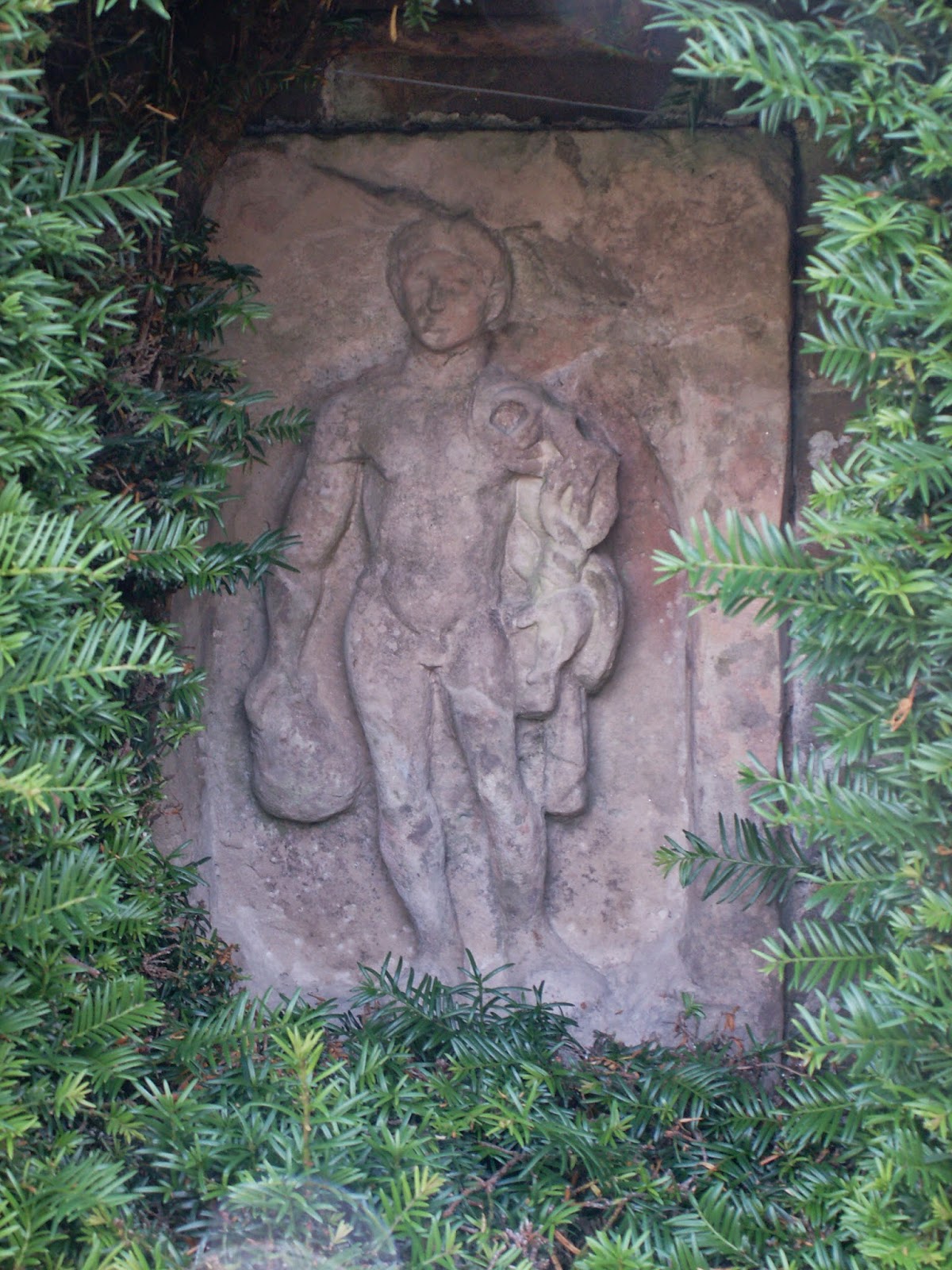
In our collections stores we have a handful of pottery sherds, an ossuary urn, fragments of timber from Birdoswald Camp on Hadrian's Wall, and two Roman oil lamps. However, if you look outside it is a very different story. The niches of the South Court yield up some archaeological joys and were actually designed specifically to display this material. Five sculpted stone altars to the gods Jupiter, Apollo, Mars, Mercury and Venus set in these niches actually come from the Roman fort of Voreda at Old Penrith. 

Altar to Mars, God of War, in the Abbotsford South Court
Chancellor Richard Ferguson, the President of the Cumberland and Westmorland Antiquarian Society (founded in the Victorian period), understood how much Voreda had captured Scott's imagination, claiming that the writer “ had made it a practice never to go south without stopping at it and meditating upon it.” Indeed Sir Walter’s journal entry of April 4 1828 mentions that “in our stage to Penrith I introduced Anne to the ancient Petreia, called Old Penrith.” Now, whether you agree with the circumstances in which Walter acquired such treasures or not, it is somewhat of a relief that the altars have been displayed together as a group - albeit interspersed with roundels from the Mercat Cross! Another inscribed stone in the South Court was carved by a detachment of a legion active 'between the walls'. At first this inscription was thought to come from Voreda, but, much like the brass pots, it may in fact hail from the Antonine Wall area. If the tiny figure outside of the border is interpreted as a depiction of Capricorn, it provides valuable information on the movements of the Twenty-second 'Primigenia' Legion, who used it as one of their symbols.

I thought I'd finish with a wonderful excerpt from the American author Washington's Irving's account of visiting the Abbotsford estate.  

'In the course of our morning's walk, we stopped at a small house belonging to one of the labourers on the estate. The object of Scott's visit was to inspect a relic which had been digged up at the Roman camp; and which, if I recollect right, he pronounced to have been a tongs...As he stood regarding the relic, turning it round and round, and making comments upon it, half grave, half comic, with the cottage group all around him...I seemed to see before me that prince of antiquarians and humorists, holding forth to his unlearned and unbelieving neighbours.'  

I hope you've enjoyed reading about a few of our true antiquities today. 
  
Thanks for joining us!

Kirsty Archer-Thompson
Heritage and Engagement Manager

Wednesday, 17 June 2015

Field Marshal Blücher's Tiny Teapot and Other Adventures...


Earlier this week, our volunteers were treated to a trip up to the National Museum of Scotland in Edinburgh. As with all staff get-togethers, it was long overdue and offered a rare opportunity for volunteers based in different areas to meet one another properly and have some fun!

Of course, this was a cultural outing and it was my mission to put together an itinerary that had some relevance to Scott. With a sprinkling of fairydust from external funders, we can ensure that this is the first of a series of excursions that will help our volunteers make associations and connections with other historical sites, people in history and major events that shaped Scott's worldview.

Perhaps no event is more significant in Scott's lifetime than the battle of Waterloo, especially when you consider it is the culmination of a pervading mood of fear and hostility that had been simmering away in Britain ever since the French Revolution, at least amongst the conservative faction. Now, I shan't harp on about Waterloo again after such a recent blog post on the subject (even if it is tempting within a whisker of the bicentenary itself), but I would like to draw attention to the first pitstop on our Scott-themed tour of NMS: an excellent little exhibition entitled 'Waterloo: After the Battle,' curated by Dr. Stuart Allan.

Our Volunteers Malcolm and Will putting Dr Allan through his paces

We were lucky enough to have Dr. Allan show us around the displays which really helped to bring everything to life. Perhaps most poignant for the Abbotsford troupe was the chance to see the captured bronze eagle of the French 45th Infantry, one of two Napoleonic totems taken by the British forces during the battle. 


The Eagle of the 45th

Why is it relevant to Scott? Well, we have an eagle at Abbotsford, albeit something a little less 'shiny...' For some time it was rumoured that this was the real deal, until it was pointed out that the whereabouts of the two captured imperial eagles was already known! Our wooden version is, we think, more likely to be a stage prop that accompanies a set of flags we have in the archives, one of which is a replica standard of the French 105th Infantry, the other regiment to lose its colours on the 18th June.  Other artfefacts on display in this exhibition included Napoleon's sugar bowl, part of a wonderfully ornate tea service (which I am sure Scott would have moved heaven and earth to get hold of if he could have done), commemorative Black Watch pottery fired in 1816, and my personal favourite: a tiny little silver teapot that supposedly belonged to Field Marshal Blücher, the septuagenarian commander of the Prussian forces. I guess he wasn't quite as butch as history would have you believe!

It appears the Prussians also marched on tea.

Wonderful rustic Scottish pottery from Portobello
After wolfing down a tasty lunch, we were treated to a fantastic tour of the Scottish galleries with George Dalgleish, Keeper of Scottish History and Archaeology. George is an Abbotsford Trustee and as such, he was able to give us a fantastic overview of the objects in the museum collection that Scott had owned, written about and seen exhibited. One of the real treasures of Abbotsford, the Torrs Chamfrein, actually resides at the National Museum after it was sold decades ago by Scott's descendents to avert ever-present financial difficulties. Luckily, the museum provided us with their Victorian replica of the artefact at the time of that transaction so visitors can still see a version of the piece in its rightful setting here at Abbotsford.


The Torrs Chamfrein at NMS, once belonging to Sir Walter Scott

Chamfreins, being ceremonial or armoured headpieces for horses, are interesting things and this one in particular is a bit of a conundrum.  There are fine examples from Roman Britain in other institutions, but this Iron Age example, dated to approximately 200BC is more likely to have been ritual in function. Whether it was made for animal or human is very much open to debate; perhaps in a shamanistic ceremony it transformed an individual from one thing to another. The pony cap and horns were unearthed in a peat bog at Torrs Farm in Dumfries and Galloway in the 1820s and given to Scott as a curiousity worthy of his 'museum for living in'. Having been found initially as two separate items in the same location, it is unclear how the cap and horns marry together both physically and chronologically but they have been displayed as one piece for some time now. Until new research can find a way to navigate the minefield of 'cult archaeology', the enigma of the Torrs chamfrein continues. 

Passing through the medieval gallery, we caught a glimpse of the famous Lewis chessmen. We were all surprised to find that Scott narrowly missed out on acquiring these, in reality due to his ailing health.


A Selection of the Lewis Chessmen
An Edinburgh Antiques dealer had put his collection of chesspieces up for the consideration of the Keeper of Manuscripts at the British Museum on the 17th October 1831 and Sir Walter Scott happened to see the relics, being present to consult manuscripts for research purposes. His journal entry that day is as follows: 'the morning beautiful today, I go to look after the transcripts in the Museum and leave a card on a set of chess men thrown up by the sea on the coast of Scotland which were offered for £100.' As the twists and turns of fate would have it, it was actually his friend Charles Kirkpatrick-Sharpe who ended up owning eleven pieces of the much larger collection. I wonder how different things would have been if he hadn't been so unwell at the time and what a joy the chesspieces would have been to have at Abbotsford!

After having wended our way past the towering Scottish Maiden, a guillotine that features in Scott's novel The Abbot, the final highlight of our tour (and there were many more than I can possibly cover here) was seeing the sporran that inspired that famous passage in Rob Roy:
 "I advise no man to attempt opening this sporran till he has my secret,'' said Rob Roy; and then twisting one button in one direction, and another in another, pulling one stud upward, and pressing another downward, the mouth of the purse, which was bound with massive silver plate, opened and gave admittance to his hand. He made me remark, as if to break short the subject on which Bailie Jarvie had spoken, that a small steel pistol was concealed within the purse, the trigger of which was connected with the mounting, and made part of the machinery, so that the weapon would certainly be discharged, and in all probability its contents lodged in the person of any one, who, being unacquainted with the secret, should tamper with the lock which secured his treasure."
 
Gentlemen, beware! Sporran clasp concealing two small steel pistols


Some cautionary tales around the Scotch Maiden

 Now, as with all items that occupy that murky border country between history and myth, this NMS item is popularly referred to as Rob Roy's sporran, and indeed it must have inspired that passage in the novel, but there is no evidence whatsoever that it ever belonged to the folk hero. As ever with these things, the popular imagination sides with the storyteller. And isn't it more fun that way? Scott would have most certainly thought so. 

I hope you've enjoyed our little virtual excursion though the National Museum of Scotland. 

Thanks, as ever, for reading!

Kirsty Archer-Thompson
Heritage and Engagement Manager


one button in one direction, another in another…when the mouth of the purse…opened… a small steel pistol was concealed within the mounting,…so that the weapon would be discharged’ - See more at: http://www.26treasures.com/creationstories/sporran-clasp-four-concealed-pistols-stuart-delves#sthash.NiWKwVcx.dpuf


Sunday, 31 May 2015

On this day in History...

Every now and then, it's rather fun to pick up Sir Walter Scott's Journal or peruse a collection of letters and find out what was happening on a particular date during his life. We haven't done this yet with the Treasures of Abbotsford Blog and this story is a perfect reminder of why we should!

Today's gem of a letter was penned by Archibald Constable, Scott's publisher of the time. It was addressed to the author at his Edinburgh home on Castle Street and composed on 31st May 1822.

A rather portly Archibald Constable
 Ostensibly, the letter serves as an update on the reception and sales of his latest novel, the Fortunes of Nigel, and Constable claims with somewhat feigned surprise that 'the press is at work again,' meaning that avid readers had already devoured the first print run, quite literally acquiring their copies 'hot off the press.' The picture painted is reminiscent of the hype surrounding a new release in the Harry Potter franchise, or even the latest Apple gadget:

' A new novel from the author of Waverley puts aside, in other words puts down for a time, every other literary performance. The Smack Ocean, by which the new work was shipped, arrived at the wharf on Sunday; the bales were got out by one on Monday morning, and before half-past ten o'clock 7,000 copies had been dispersed from 90, Cheapside.'  
Granted, this is a Victorian piece of Scott memorabilia, but I love these Minton tiles featuring scenes from the Waverley novels. Not easy to come by so I shouldn't think I'll be fashioning my home with them any time soon!


Constable's letter is interesting to me for another reason, serving as a reminder of the number of Scott's high-profile friends and associates that contributed to the diversity of the Abbotsford collections. Archibald speaks of visiting the shop of a Mr. Swaby in Warden Street. Now, I assume this is Warden's Close in Edinburgh's Grassmarket, but I could well be wrong considering he has just been talking about book sales in London. He states that he had been directed to the premises of this 'curious person' Swaby, by his son, Thomas, in order to have a closer look at an antiquated portrait of a monarch spotted there. After some discussion they decide that this is a rare jewel, an unknown portrait of King James IV (perhaps painted by Maynard Wewyck), and Constable forwards it to Scott, trusting that 'ere long, [he] will see it in the Armoury at Abbotsford.' 

The Abbotsford Armoury Wall, complete with James IV portrait purchased by Constable
There are several things going on here, but primarily the portrait is a reminder of one of the greatest successes in their long partnership, the epic poem Marmion: A Tale of Flodden Field published in 1808, the first work in literary history for which the author received a monetary advance from his publisher. Constable is well aware that Scott aims to furnish his baronial home with objects that tell stories, specifically his own version of history if he can help it, and he is keen to contribute to the creation of this shrine to storytelling. His motivation for doing so may well lie in his knowledge that Scott's collecting and his writing have a powerfully symbiotic relationship, as of course do a writer and his publisher.

When I read this letter,  it is not without a raised eyebrow and a smirk as the publisher recommends where in a home such artefacts should be displayed, but perhaps they were more 'jack of all trade' folk in the 1820s! His other purchases that day are no less important to our collection:  'two large elbow chairs, elaborately carved, in boxwood...Swaby assured me they came from the Borghese palace in Rome' and 'a slab of mosaic pavement, which I also destine for Abbotsford.' 

The Borghese Palace, original home of our beautiful boxwood chairs

Constable encourages Scott to accept the pair of chairs as furniture of a calibre appropriate for the Library at Abbotsford, and the mosaic as a hearth-stone for one of the fireplaces. The chairs do indeed still stand either side of the fireplace in the library today but, thankfully, Archibald's mosaic slab forms a handsome table top rather than a hearth, preserving the exquisite piece from excessive wear and tear over the last two centuries. Supposedly there were originally ten Borghese chairs, six of which went to Belvoir Castle in Leicestershire and still stand in their Picture Gallery there to this day. I would dearly like to know where the other two have ended up!

The Abbotsford Library. You can see one of our Borghese chairs to the left of the fireplace


Belvoir Castle has a very different interior to Abbotsford, but if you look closely you can see something familiar!

Hopefully this post illustrates how archival material can help bring collection pieces to life - in just one letter, we have mapped out where these pieces were purchased, by who and for what reasons. If only we were so lucky with mapping the stories of all of our gabions and curiousities! If you think you might know the whereabouts of Swaby's or indeed the other two Borghese chairs, please do get in touch and help us build a clearer picture of this fascinating springtime exchange one hundred and ninety-three years ago. 

'It occured to me that these three articles might prove suitable to your taste, and under that impression I am now induced to take the liberty of requesting you to accept them as a small but sincere pledge of grateful feeling. Our literary connexion is too important to make it necessary for your publishers to trouble you about the pounds, shillings and pence of such things.'  Archibald Constable, 31st May, 1822. 

Thanks for reading!

Kirsty Archer-Thompson
Heritage and Engagement Manager


Saturday, 16 May 2015

Scott on Waterloo

'Bones of horses , quantities of old hats, rags of clothes, scraps of leather and fragments of books and papers strewed the ground in great profusion...'

This was the sight that greeted Sir Walter on his visit to the battlefield in August 1815. Indeed, he had felt full of such fire to make the trip that the venture would see him take his very first steps on foreign soil. The words themselves, although a reflection of Sir Walter's own experiences, come from the eponymous narrator of Paul's Letters to his Kinsfolk, a strange work that purports to be a series of letters penned for five different recipients back home. In effect, this short work is Scott's closest brush with journalism. A brand new edition of this fascinating text, along with The Field of Waterloo and 'the Dance of Death,' was published at the end of April this year and we were delighted to assist Penguin Random House with the cover!


Front Cover Photograph showing the Soldier's Book and Tricolour Cockade from the Abbotsford Collections

On the evening of Tuesday 12th May we were very fortunate to welcome Dr. Paul O' Keeffe, the editor of this new publication, to Abbotsford to introduce his new book and talk a little more about Scott's battlefield visit in the run up to the bicentenary of Waterloo next month. The evening was a wonderful, theatrical affair (with belly laughs aplenty), but it was not without a suitable dose of the macabre.

A very charismatic Paul O' Keeffe as Ruskin at the Edinburgh Fringe Festival

 Battlefield tourism seems a pretty alien pastime to our modern sensibilities; nowadays when we visit the sites
of previous conflict, say the Somme, Culloden or Waterloo,  we are fuelled by a thirst for knowledge or a need to pay our respects. Curiousity and the sense of reaching out and touching history was certainly still a motivating factor for visitors to Waterloo in 1815, but when you consider that a few intrepid onlookers started arriving the morning after the battle, presumably jostling with the local peasants ransacking valuables from the dead, something quite different was at work. There was a powerful sense that Waterloo was the key battle of the time and tourists were eager to acquire souvenirs from the field. 

Napoleonic Plaque displayed in the Abbotsford Entrance Hall

O'Keeffe had the audience grimacing suitably as he evoked the dizzying stench of poorly buried mass graves, human bodies slowly baking just below the surface in the stifling heat of summer. The battlefield area was relatively small and could be explored easily on a day excursion from Brussels but once visitors arrived, they would have found it essential to have packed both quantities of snuff and an iron constitution!

French Cuirassier's Steel and Brass Breast and Back Plate and to the right, a copy of the Imperial Eagle Standard

By the time Sir Walter Scott arrived on the scene, the craze for Waterloo relics had spawned a veritable marketplace where nearby villagers successfully flogged weaponry and cuirasses to awestruck tourists. The bodies had been long stripped but not long buried and Scott encounters an eerie landscape strewn with paper and rags. He set about picking up smaller relics and arranging the purchase of more impressive artefacts over the duration of his trip. One of his most treasured acquisitions, a French soldier's book now in the Abbotsford collections, is photographed on O' Keeffe's book cover. In amongst the cuirasses, sabres, pistols and Napoleonic totems, it is fitting that this little book has been given pride of place. With papers flitting in the breeze before him as far as the eye could see, these military livrets were far from a rarity but they offered a tangible link with an individual life. Scott finds his soldier's book to be a very personal snapshot of a life snuffed out, 'and with it, all his earthly hopes and prospects.'  


Thanks for reading!

Kirsty Archer-Thompson
Heritage and Engagement Manager

Wednesday, 22 April 2015

Bookish Banter


On the 23rd April many countries around the world will be celebrating World Book Day (something that the UK has done in recent years a month earlier). This date was originally chosen to coincide with the date of William Shakespeare's death, probably the most famous wordsmith in history. In honour of Sir Walter's lifelong admiration for the Bard, I thought bookish banter should be the order of the day!

Over the past week or so we have been beavering away, armed with our trusty gloves, archival tape and camera, condition-assessing the books on display in our free to access exhibition in the Abbotsford Visitor Centre. Walter Scott's library at Abbotsford is a rare thing indeed, and not just because Sir Walter thought it the 'handsomest room in Scotland'! Most personal libraries of writers, statesmen and academics end up dispersed or at the very least, depleted after the death of the original owner as items are discarded or claimed by various living relations. Particularly significant collections may be absorbed in their entirety into larger museum or institutional collections. The fact that Scott's library remains wholly intact and that the volumes sit on their shelves in the very position they occupied during the author's life, is remarkable, and one of the many reasons that we now treat the collection as a conservation library. Direct access to the books, even for researchers, is something strictly governed to ensure their long-term survival.  For this reason, one of the most rewarding parts of  my work is selecting a handful of these books for public display, offering visitors a rare glimpse inside the front covers. In the last changeover alone we added an edition of Tam o' Shanter annotated in Robert Burns' own hand, a manuscript revealing Scott's first attempts at copying Icelandic sagas and one of the world's first historical novels, Guerras civiles de Granada

Scott's 1791 edition of Tam o' Shanter


Now, it would of course be a travesty for the literary property of a lifelong bookworm such as Scott not to form a significant part of the exhibition on his life and work. However, from the standpoint of a Heritage team, paper is one of our more high-maintenance friends! Every January we have a complete changeover of all the books displayed in the Visitor Centre and then every three months, all those books have to be assessed to see how they are coping with display, with very few books permitted to remain on display for more than six months at a time. On the face of it, this may seem nonsensical. How could a book visibly change in a matter of months whilst locked away in a case?! You'd be surprised.   

Scott's personal bindings displaying his portcullis symbol and motto: Clausus Tutus Ero (roughly translates to 'Closed in I am safe), quite appropriate for the contents of a conservation library! 


When shelved, the books at Abbotsford are kept in an stable, environmentally controlled setting, packed fairly tightly with a gap at the back to ensure adequate air flow. Some of the books owned by Scott are contemporary with his life and writings but others were antiquarian treasures even by his standards. For books, the display process is all about finding the right angle for pitch and opening that puts the least strain on the binding. Sometimes, fascinating books we would love to display simply don't make the cut because they're too fragile. Others need to be carefully monitored to ensure they don't start to warp or gape when you attempt to close them and this is what we've been checking and photographing over the last few days for those books currently on open display. Pages also need to be turned to try and mitigate the damaging effects of UV light. For those books that are already showing any signs of structural deterioration at this three months check, it is the end of the road for their display and replacements on a similar theme must be sought. And thus the cycle continues.... but we wouldn't have it any other way!

The visual warning signs that a volume is not suited to prolonged display - Scott's copy of Halidon Hill.

The moral of the story is this: if you are a particular fan of an exhibition or museum that displays rare books, make sure you return every few months because you're always likely to see something new. For Abbotsford this time will come in the summer, so why not come and see our latest discoveries for yourself? 

Thanks for reading!

Kirsty Archer-Thompson
Heritage and Engagement Manager